BMW 50 Years M: why the 1973 badge returned
In 2022, BMW turned 50 and reissued the staggered-semicircle emblem from half a century earlier. The tricolor has a stranger origin than most people realize.
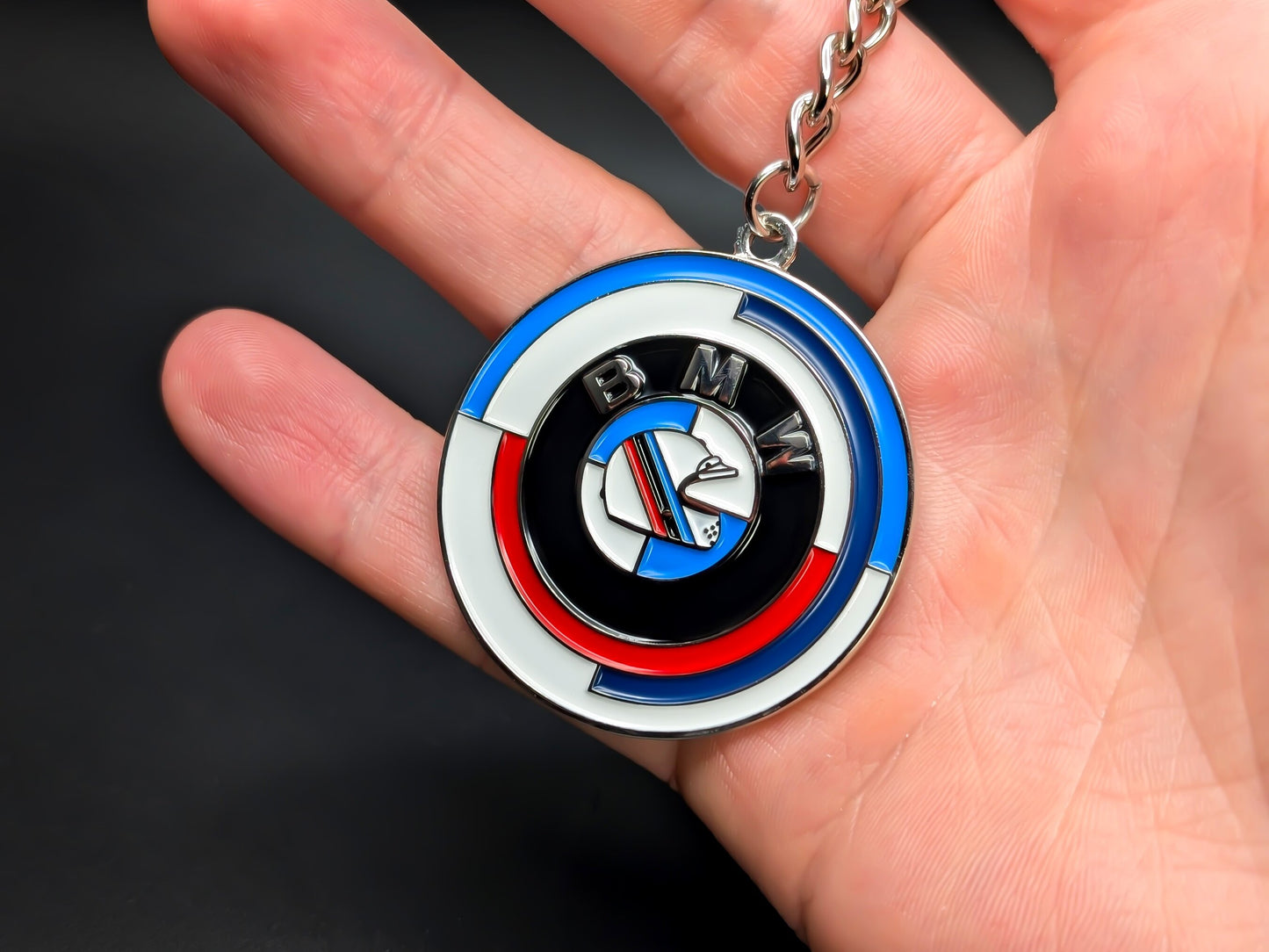
The BMW 50th anniversary badge is a revival of the original 1973 BMW Motorsport emblem, first designed for the racing division's debut season on the 3.0 CSL. BMW M GmbH was founded on May 1, 1972, and to mark its golden jubilee on May 24, 2022, BMW revived that classic staggered-semicircle roundel under factory option code 3MQ. The badge features the standard BMW roundel at the center, encircled by offset concentric bands in light blue, violet, and red, with the letters "BMW" rendered in raised polished silver rather than the flat white print of the standard emblem.

The original 1973 BMW Motorsport emblem designed by the Müller agency.
On a current G80 M3, that emblem is disorienting in the best way. It is the same badge the 3.0 CSL wore in 1973, the car's debut ETCC season. BMW did not design something new for the anniversary. They went back fifty years and retrieved something they had almost let disappear entirely.
Where the tricolor actually came from
The standard story, the one BMW now tells officially, is that the three stripes mean something symbolic: blue for the BMW brand, red for motorsport, and violet for the connection between the two. That explanation is clean, logical, and arrived after the fact.
According to Marc Thiesbürger, automotive and racing historian for BMW Group Classic, early design drafts for the 3.0 CSL emblem prepared by BMW interior designer Wolfgang Seehaus in 1972 explicitly integrated the Texaco corporate logo. BMW was in active sponsorship negotiations with the American oil company at the time, and Texaco's primary corporate color is red. The blue stripe represented Bavaria and the BMW brand. The violet was a pragmatic blend of the two. When negotiations with Texaco collapsed at the end of 1972, the design team kept the layout and retroactively reframed what the colors meant. Hagen Nyncke of the BMW Group Archiv confirmed this directly: "It is true that in the early beginnings of BMW Motorsport the color red was planned as a link to Texaco as a sponsor. However, the M colors do not stand for any sponsorship but have a meaning of its own."
Seehaus also had a practical reason to choose that palette. In 1972 and 1973, most print media and television coverage was still predominantly black and white. Blue, violet, and red contrast sharply enough that the three bands stayed readable in monochrome newsprint. Racing sponsorship graphics had to work in both worlds.
The design concept for the circular emblem originated with the Swiss graphic design agency Müller. The final racing livery for the 3.0 CSL was developed by external graphic specialist Pierre Mendell of the Pierre Mendell Design Studio working in close cooperation with Manfred Rennen. Neerpasch, Seehaus, and Rennen were the three figures at the center of the visual identity work during those founding months. Their emblem debuted on the 3.0 CSL's bodywork in 1973.
The car won the European Touring Car Championship that debut season and went on to claim six ETCC titles in total (1973 and 1975 through 1979).

The 1978 BMW M1, the car that introduced Giorgio Giugiaro’s italicized “M” alongside the original circular emblem.
How the emblem was quietly retired, then officially revived
In 1978, when BMW developed the M1, it commissioned Italian designer Giorgio Giugiaro to handle the exterior and sharpen the brand's visual identity. Giugiaro integrated the tricolor scheme with a bold italicized letter "M," placing three rightward-slanted beveled stripes alongside the letterform. That logo became the "Giugiaro M" and eventually the dominant face of BMW M across all markets. The M1 was the only production road vehicle to carry both the original circular heritage emblem and the new Giugiaro M tricolor stripes simultaneously. The classic circular Müller-designed emblem was never permanent, and over the following decades the violet shifted toward a deeper blue. In March 2020, BMW M executed a flat two-dimensional refresh of its communication logo.
Option code 3MQ brought the 1973 design back as a physical badge. Orders opened in late January 2022 and production ran from March 2022 through early 2023. In the United States, the heritage badge was applied as standard equipment on all full-performance M models built within that window: the M3, M4, X3 M, X4 M, X5 M, and X6 M. Mid-tier M Performance vehicles such as the M340i and M440i could add it as a factory option. Vehicles equipped only with the cosmetic M Sport Package were ineligible.
The badge came in two primary sizes. The 74mm version (part number 51-11-7-886-545) fits the hood of the G80 M3, G82 M4 Coupe, M4 CSL, and M4 Convertible. The 82mm version (part number 51-14-8-087-190) covers the G42 2 Series Coupe, the G22 and G23 4 Series, and the G26 i4. Both were released as standalone OEM accessory parts, which triggered a substantial wave of aftermarket retrofitting on older M cars and M Performance models that missed the factory window.
What the badge actually signals
BMW M was launching the XM, its first electrified high-performance model, at the precise moment enthusiasts were most anxious about what electrification would do to the M identity. The 3MQ badge revival dropped into that context deliberately. Franciscus van Meel, Chairman of BMW M GmbH, said at the anniversary: "The M has long been considered the strongest letter in the world, and in our company's anniversary year it is stronger than ever." The accompanying reintroduction of 50 historic paint finishes, including Dakar Yellow, Fire Orange, Daytona Violet, Imola Red, and Laguna Seca Blue, said the same thing: the division knows where it came from.

BMW M’s 50th-anniversary launch in 2022: current M models carrying the revived 1973 roundel as standard.
The staggered-semicircle roundel had spent roughly four decades as an archival item, something you saw on a museum 3.0 CSL or a period racing photograph. Car and Driver covered the badge's return in 2022. Whether the Texaco origin story diminishes the tricolor's meaning or deepens it probably depends on how much you care about the gap between corporate mythology and what actually happened in a Munich design studio in 1972. BMW built a clean symbolic narrative from a collapsed sponsorship deal. That it held for fifty years is either remarkable or telling, depending on your disposition.
In summary
What is the BMW 50th anniversary badge?
The BMW 50th anniversary badge is the original 1973 BMW Motorsport roundel reissued under factory option code 3MQ for models produced from March 2022 through early 2023. It has the standard BMW roundel at the center, surrounded by staggered semicircular bands in light blue, violet, and red, with raised polished silver lettering.
Why does the BMW M logo have blue, violet, and red?
BMW's official explanation is that blue represents the brand, red represents motorsport, and violet represents the connection between the two. BMW Group Classic historian Marc Thiesbürger found in archival research that the red stripe originally referenced Texaco's corporate color during sponsorship negotiations in 1972. When those negotiations collapsed, BMW kept the design and assigned the symbolic meaning afterward.
What is BMW option code 3MQ?
Option code 3MQ is the factory designation for the 50 Years M Heritage Badge. It was standard equipment on full-performance M models (M3, M4, X3 M, X4 M, X5 M, X6 M) built from March 2022 through early 2023, and optional on M Performance variants. Models with only the M Sport Package were not eligible.
What car first wore the BMW Motorsport staggered-semicircle emblem?
The BMW 3.0 CSL debuted the emblem in 1973. The car won the European Touring Car Championship that season and went on to take six ETCC titles in total, from 1973 and then 1975 through 1979.
What sizes does the BMW 50th anniversary badge come in?
The primary sizes are 74mm (part number 51-11-7-886-545) for the G80 M3, G82 M4, and M4 CSL, and 82mm (part number 51-14-8-087-190) for the G42 2 Series, G22/G23/G26 4 Series, and G26 i4. BMW also released 56mm wheel center caps and 50mm LED door courtesy light projectors in the anniversary design.
Who designed the original 1973 BMW Motorsport emblem?
The concept came from Swiss graphic design agency Müller. Wolfgang Seehaus (BMW interior designer), Manfred Rennen (BMW exterior designer), and external graphic specialist Pierre Mendell of the Pierre Mendell Design Studio finalized the emblem under racing division head Jochen Neerpasch.