The History of the GMC Truck Logo
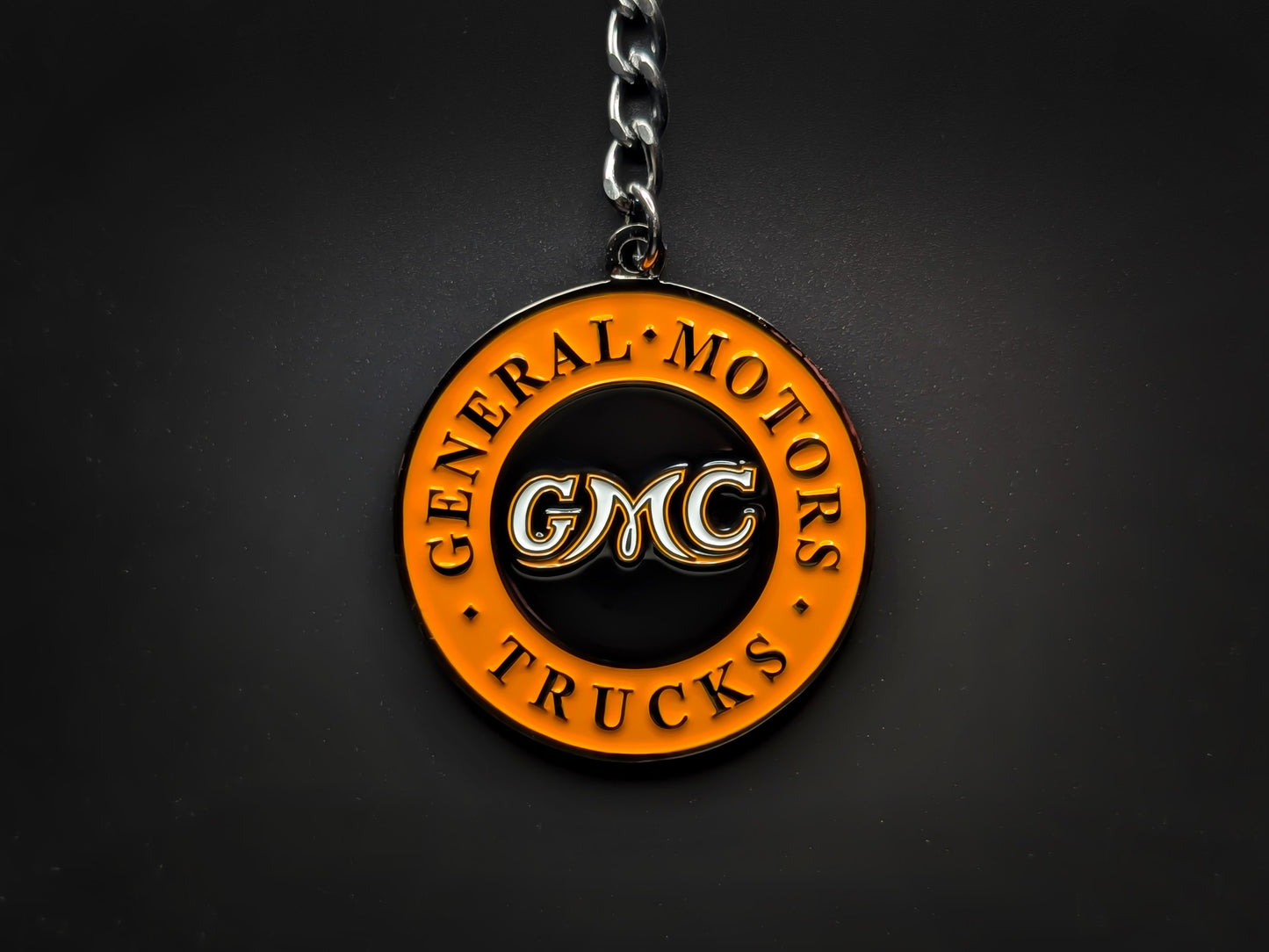
The old orange roundel spells out General Motors Trucks. GMC later shrank that full name to three red letters.
The GMC truck logo began as the mark of the General Motors Truck Company, formed in 1911 when William C. Durant combined the Rapid and Reliance truck builders under one roof in Pontiac, Michigan. The GMC initials reached production trucks in early 1912, and the orange-ringed "General Motors Trucks" roundel comes from the brand's early decades, though no reliable record gives its exact years. The red block "GMC" lettering most people know was finalized in 1966, and General Motors dropped the word "Truck" from the name in 1996.
Read the badge on this keychain left to right and the order of words tells you what the brand was for. General Motors comes first, Trucks comes last, and GMC sits in the middle as shorthand. Before GMC was a Denali trim level, it was a division built to sell work, and that origin explains almost every emblem it wore for the next hundred years.
A merger that needed a name
Max and Morris Grabowsky founded the Grabowsky Motor Vehicle Company in Detroit in 1900, moved to Pontiac in 1902 and renamed it the Rapid Motor Vehicle Company. In 1909 a Rapid became the first truck to climb Pikes Peak. That same year General Motors took controlling interests in Rapid and in the Reliance Motor Car Company, a heavy-truck builder in Owosso. Durant wanted commercial vehicles as a counterweight to the swings of the passenger car market. In 1911 he folded both companies into the General Motors Truck Company, with production centered in Pontiac.
The initials came next. GMC appeared on trucks in early 1912 and made its public debut at that year's New York show. The division built 372 trucks that first year. Early identification was plain, just stencils, decals and stamped tags on wooden cabs. The roundel with black serif capitals spelling out "General Motors Trucks" around an orange ring, separated by small dots, is usually filed under that opening phase. Here the record is thin. No reliable source dates it, and nothing confirms it came before the cast-iron script, so no firm year belongs on it. Whatever its date, the logic holds: the badge spells out the name the initials stand for.

A 1908 advertisement from the Rapid Motor Vehicle Company of Pontiac. General Motors took a controlling interest in Rapid in 1909.
Cast iron, enamel and chrome
The initials soon had to carry the brand alone. From 1914 GMC trucks wore a heavy cast-iron script on the radiator tank, 197 mm wide and 74 mm tall, painted black at first and white from around 1919. The 1920s brought fired enamel: an 87 mm blue and white oval on the Model 16 and K-16, then a 70 mm circle with the 1927 T-Series, offered in orange, blue and white among other combinations. From 1938 to 1947 long cast plaques spelled out "General Motors Truck" along the hood sides. After the war, from 1948 to 1954, a 395 mm chrome "GMC" took over the grille bar.
Corporate ownership shifted behind those badges. In 1925 Alfred Sloan's General Motors took control of Yellow Cab and Yellow Coach, creating the Yellow Truck & Coach Manufacturing Company. For nearly two decades buses wore Yellow Coach and trucks wore GMC, until GM bought the remaining shares and absorbed the company in September 1943. By then the war had made commercial badges beside the point. Roughly 520,000 CCKW 2.5-ton 6x6 trucks were built between 1941 and 1945, and those carried Army stenciling instead of chrome.

Arthur Dahl at the wheel of a 1922 GMC truck. From 1914 GMC trucks wore a cast-iron script on the radiator.

Chrome GMC lettering on a GMC 100 pickup. After the war, from 1948 to 1954, a chrome GMC took over the grille bar.

An enamel GMC badge with the full name spelled out around the rim. The 1920s brought fired enamel to GMC trucks.
The red block and the missing word
In mid-1955 GMC's Blue Chip trucks arrived alongside Chevrolet's Task Force, with a wraparound windshield and GMC's first light-truck V8, sourced from Pontiac. Canada got an odd one. The GMC 9300 Stepside wore GMC trim over Chevrolet engines, so the badge and the powertrain told two different stories.
Then, in 1966, the identity was reset. The red block "GMC" letters dropped the script and the roundel for flat, wide, equal-weight capitals, red with a thin black stroke and a chrome frame. The sources do not name a designer. The letters have barely changed since, apart from the 3D bevel added in 2014.
The name changed instead. In 1996 General Motors officially dropped "Truck" from the marque and repositioned GMC as a premium light-vehicle brand. The Denali sub-brand followed on the 1999 Yukon. The word that sat at the bottom of the old roundel was gone, which is why the vintage badge reads like a different company.

A GMC 150 pickup from the Blue Chip line, which arrived in mid-1955 with a wraparound windshield.

The red block GMC letters on the grille of a school bus. They date to 1966 and have barely changed since.
The roundel on the keychain spells out the whole job description: General Motors, Trucks. The red block that followed kept the letters and let go of the rest.
In summary
When was the GMC logo created?
The GMC name came with the General Motors Truck Company in 1911, and the initials appeared on production trucks in early 1912. The red block lettering used today was finalized in 1966.
What does GMC stand for?
GMC stands for General Motors Truck Company, the division William C. Durant formed in 1911 from the Rapid and Reliance truck builders. It was built to sell commercial vehicles.
What does the vintage General Motors Trucks badge look like?
It is a round emblem with an orange outer ring carrying black serif capitals that read General Motors Trucks, separated by small dots. No reliable record gives its exact years.
Why did GMC drop the word Truck?
General Motors dropped "Truck" from the name in 1996, when the lineup had grown to include vans and SUVs. GMC moved upmarket from there, and the Denali sub-brand followed on the 1999 Yukon.
Was the GMC logo ever different from the red block letters?
Yes. Before 1966 GMC used stencils, cast-iron scripts, enamel ovals and circles, long hood plaques and chrome grille letters. The red block replaced them in 1966.