Chrysler Plymouth Mayflower emblem: 73 years of badge design, one origin myth
From a detailed 1928 clipper ship to a minimalist 1990s racing yacht, the Chrysler Plymouth Mayflower badge traced every major turn in American industrial design across seven decades.
The Plymouth Mayflower ship emblem was adopted when Chrysler launched the Plymouth division on July 7, 1928, at Madison Square Garden. The ship referenced the 17th-century vessel that carried Pilgrim settlers to Massachusetts in 1620, but the real reason for the name had nothing to do with Pilgrims. It had to do with rope. Over 73 years, from a detailed 1928 clipper badge to a minimalist late-1990s racing yacht silhouette, the Mayflower emblem tracked almost every major shift in American industrial design before the brand was retired on June 29, 2001.
The 1929 sales brochure said the car shared the "endurance and strength, ruggedness and freedom from limitations" of the Pilgrim colonists. That line became the official story, sustained for decades. A ship was the natural visual anchor for that claim. And a ship, rather than Plymouth Rock, made design sense for a different reason: a ship moves. Plymouth Rock is static. A 17th-century sailing vessel under full sail conveys exactly what an automobile needs to convey: forward motion, exploration, the idea of going somewhere.

First Plymouth radiator emblem (1928)
The twine story the brochures didn't mention
But the myth was layered on top of something more prosaic. The name was proposed by Joseph Washington Frazer (1892-1971), a Yale-educated executive who had risen through Packard, General Motors, and GMAC before landing at the Maxwell-Chalmers Motor Company, reorganized as the Chrysler Corporation in 1925. In a strategy meeting with Walter P. Chrysler about the upcoming low-priced car, Frazer asked a pointed question: "Why not call it Plymouth? Ever hear of Plymouth Binder Twine?"
According to the 1920 United States Census, over 31 million people were living on farms, roughly 30 percent of the total US population. The Plymouth Cordage Company, founded in Plymouth, Massachusetts in 1824, produced the heavy-duty binder twine that held harvested grain sheaves together across the country. Every farmer knew the brand name. Chrysler, a Kansas native with deep rural roots, understood immediately. His response: "Every goddamned farmer in America has heard of that!"
The Plymouth Cordage Company had also used the Mayflower ship in its own branding for years. So the move fit without friction: adopt the ship, attach the Pilgrim narrative, and land simultaneously in agrarian familiarity and civic mythology. The badge on the 1928 Model Q radiator grille, a rectangular enameled brass piece measuring 41mm by 32mm, showed a detailed white clipper ship in rear three-quarter profile, arched by the Plymouth nameplate, with "Chrysler Corporation" text along the base above stylized wave lines. That layout established the visual grammar that would persist, in various stylistic registers, for seven decades.

From cloisonne to jet age: how the badge changed shape
The Mayflower emblem spent the 1930s being reshaped by the same forces reshaping every car on the road. As aerodynamic streamlining displaced upright boxy forms, the ship went with it. By 1934, early Plymouth sedans carried sharp stylized chrome interpretations mounted in tall winged surrounds that stressed forward velocity through flight associations. By 1936, the physical ornaments had lengthened into sweeping horizontal sculptures, die-cast in zinc, the teardrop framing stretched down the center seam of the hood.
The 1931 model year brought a notable interruption. Chrysler commissioned sculptor Avard Tennyson Fairbanks, Ph.D. (1897-1987), then an associate professor at the University of Michigan-Ann Arbor, to translate a new engineering feature into physical form. The 1931 PA series introduced "Floating Power": shock-absorbing rubber engine mounts that isolated vibration from the chassis and let a four-cylinder engine ride with the smoothness of an eight. Fairbanks negotiated a characteristically direct deal: he would design the radiator cap ornament in exchange for a new car.
What he delivered was a winged mermaid rising from a swirling wave, head held high, hair flowing backward, eagle wings extending from the shoulders. Fairbanks was compensated with a red 1932 Chrysler Royal Eight in place of cash. The public called it the "Flying Lady." Fairbanks insisted it was a mermaid, pointed to the fish-scale ridges where the figure emerged from the waves, and defended the proportions with a line that deserves to be better known: "She's a mermaid, and that's just how mermaids are!" The ornament ran only on the 1931 PA and 1932 PB series. Plymouth returned to the ship motif in 1934.

Plymouth PC Sedan Hood Ornament (1933)
The pre-war decorative peak arrived with the 1941 and 1942 model years: intricate cloisonne Mayflower ship grille emblems and multi-colored enameled shields that pushed the badge's complexity further than it would ever go again. After the war, Plymouth designers incorporated new acrylic chemistry. The 1947 Business Coupe used a clear plastic hood ornament that ghosted the Mayflower inside translucent material, catching light as the car moved. The 1951 Cambridge went further in the opposite direction: the "Flying Mayflower" hood ornament merged a stylized ship's prow with swept-back aircraft wings, a direct response to the decade's aerospace obsession.
The badge that outlived the car
The Mayflower disappeared for 27 years. Virgil Exner's "Forward Look" styling killed it: flat hoods, towering tail fins, a visual language in which an upright sailing ship simply had no place. The emblem was reduced to a small flat front-end badge on the 1957 Belvedere, dwarfed by the car's cathedral-style taillights, then retired from the sheet metal entirely. In 1961, Plymouth replaced it with a stylized vertical rocket over a red-and-blue split pentagon, pulling Space Race iconography straight onto the hood. In 1969, Plymouth adopted Chrysler's five-pointed Pentastar, designed by Lippincott and Margulies in 1962 and in use on Chrysler products since 1963.
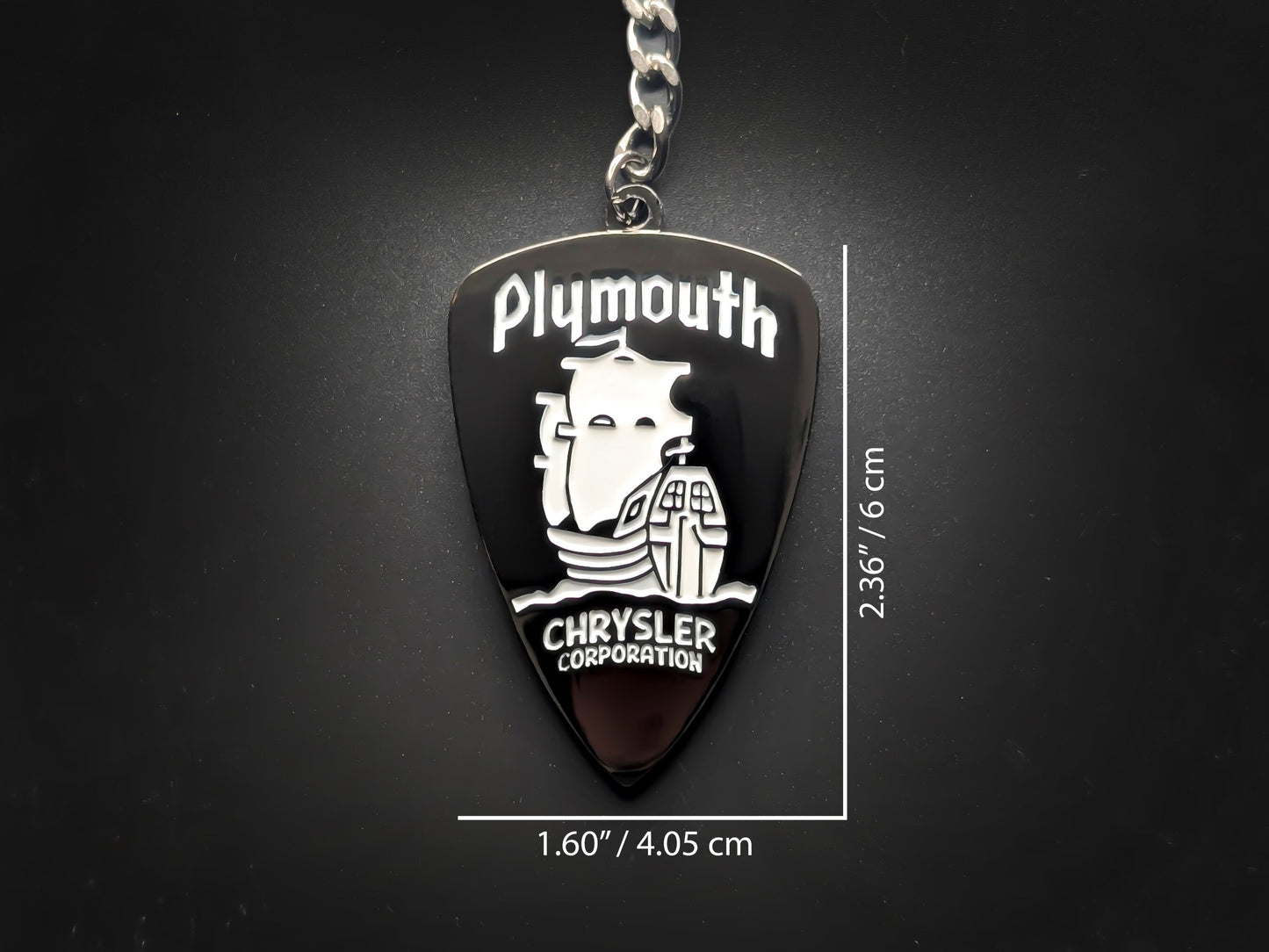
The 1996 badge that brought the ship back looked nothing like the 1928 original. Where the first version showed a detailed square-rigged clipper in brass enamel, this one was minimalist: a white clipper ship on black, rendered closer to an America's Cup racing yacht, with razor-sharp sail lines and an aerodynamic hull, set inside a circular chrome frame with white Plymouth lettering. The Plymouth division was struggling, and designers were reaching back toward the retro-futuristic styling of the Plymouth Prowler. The 1000logos.net Plymouth logo history documents the transition from the Pentastar years to this final iteration clearly. The redesign tried to connect the brand's founding myth to a contemporary performance identity. It did not reverse the commercial slide. On June 29, 2001, DaimlerChrysler discontinued Plymouth and the Mayflower came down for good.

The black shield badge with its white sailing ship under full sail carried both of Plymouth's founding stories at once: the Pilgrim mythology that played on national pride, and the binder twine familiarity that worked on agricultural common sense. Two stories, one badge, neither one canceling the other out.
In summary
Why did Plymouth use a Mayflower ship as its emblem?
Plymouth adopted the Mayflower ship because the brand name referenced the vessel that carried Pilgrim settlers to Massachusetts in 1620, which made a ship the obvious visual anchor. The Plymouth Cordage Company, a major binder twine manufacturer, had already used the Mayflower in its own branding for years, so the image carried built-in recognition in rural American markets. A ship was also preferred over Plymouth Rock because a ship conveys motion, which suits an automobile.
What was the real reason Plymouth was named Plymouth?
Joseph Washington Frazer proposed 'Plymouth' by pointing to the Plymouth Cordage Company's binder twine, known to over 31 million people living on farms, roughly 30 percent of the total US population in 1920. Walter Chrysler, a Kansas native who understood rural markets, grasped the built-in name recognition immediately. The patriotic Pilgrim narrative came later, the public version dressed over an agrarian calculation.
Who designed the Plymouth 'Floating Power' hood ornament mermaid?
American sculptor and anatomist Avard Tennyson Fairbanks, PhD (1897-1987), designed the winged mermaid for the 1931 Plymouth PA series, taking a red 1932 Chrysler Royal Eight in lieu of cash. The ornament referenced Plymouth's new rubber engine mounts, which cut vibration enough that a four-cylinder engine could ride as smoothly as an eight.
How did the Plymouth Mayflower emblem change over the decades?
The emblem opened as a detailed 1928 clipper ship on a rectangular enameled badge, then moved through streamlined Art Deco sculptures in the 1930s, cloisonne enamel shields in the early 1940s, translucent acrylic ornaments in the late 1940s, and a jet-age 'Flying Mayflower' with aircraft wings in 1951. After the physical hood ornament was retired in the late 1950s, the Mayflower came back in 1996 as a minimalist America's Cup racing yacht silhouette before the brand was discontinued in 2001.
When did Plymouth stop using the Mayflower emblem?
The physical Mayflower hood ornament was retired in the late 1950s as flat hood designs made upright mascots obsolete, replaced by a rocket emblem in 1961 and then the Chrysler Pentastar in 1969. The Mayflower returned in 1996 in modernized form, but Plymouth as a brand was discontinued on June 29, 2001, ending the emblem for good.
Was Plymouth really named after Plymouth Binder Twine?
Yes, that's the credible internal account. Frazer's pitch to Walter Chrysler centered on the Plymouth Cordage Company's name recognition among American farmers, and Chrysler's reported reaction confirms the agricultural association was what sold him. The patriotic Pilgrim narrative was the public-facing version; the twine recognition was the strategic logic underneath it.