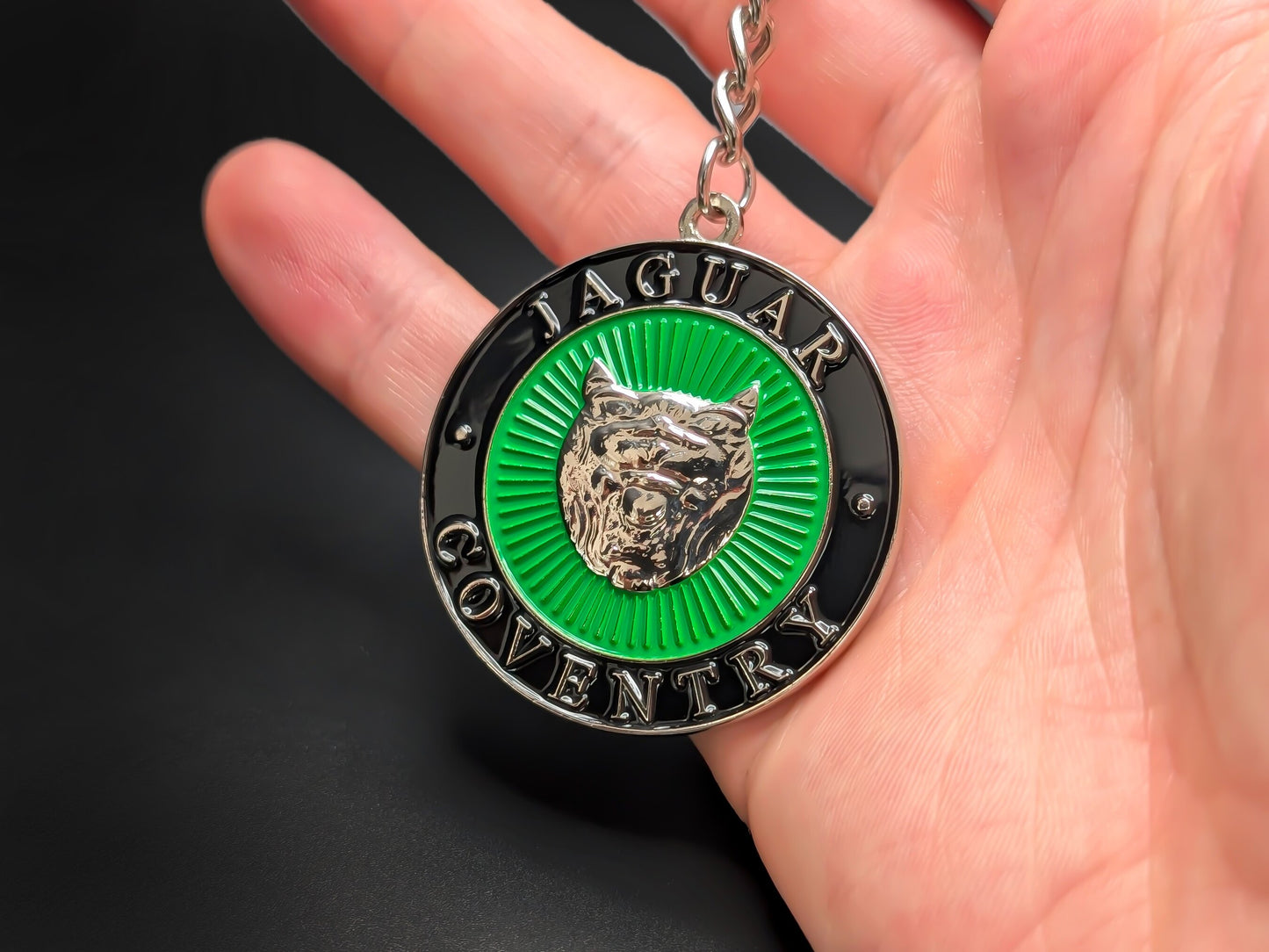
Jaguar Growler emblem: origin, symbolism, and 74 years on the nose
The Growler spent 74 years staring down the road from Jaguar’s grille. Here’s where it came from.
The Jaguar Growler is the front-facing, roaring-cat circular emblem that debuted in 1950 on the bonnet of the XK120 sports car. Where the Leaper, Jaguar's other mascot, shows the cat in profile mid-stride, the Growler confronts the viewer head-on: bared fangs, pinned ears, the face of something that is not running away. The two emblems coexisted for most of Jaguar's modern history, each making a different case for what the cars were. In 2024, after 74 years on the grille, the Growler was officially retired when Jaguar restructured itself around a new all-electric identity.
From a sculptor's dissatisfaction to a bonnet badge
William Lyons hated the first attempt. At the time the company was still called SS Cars Limited, and Lyons had commissioned a leaping-cat hood ornament in 1938. According to Magneto Magazine, he described it as looking like "a cat shot off a fence." He handed the project to his marketing chief Bill Rankin, and the commission went to Frederick Gordon Crosby, a respected automotive illustrator, who shaped the finished mascot. Crosby's finalized three-dimensional Leaper was introduced in December 1938 and became the aesthetic DNA for every cat emblem that followed.
Then the war intervened, and with it came a naming problem. The abbreviation "SS" had acquired an association with the Nazi Schutzstaffel that the company could not carry forward. At a shareholder meeting in 1945, the firm became Jaguar Cars Limited. The abstract, winged pre-war badge was abandoned in favor of the feline motif Lyons had spent years developing.
The Growler itself arrived five years later. When the XK120 launched in 1950, it wore a circular badge on the bonnet featuring the front-facing roaring cat head in relief, framed in a round metallic bezel. Early examples were enameled brass, often cast by J. Fray of Birmingham, finished with hand-applied vitreous porcelain enamel. The cat's face was cast separately from the circular base, a two-piece alloy construction that gave the badge its depth. Hemmings notes that these badges were built with the kind of craft attention the rest of the cars also received.
Two mascots, two arguments
Motion is what the Leaper argues, on a horizontal axis: speed, a cat covering ground. It is the mascot of Grace, Space, Pace, the three-word brand promise Jaguar developed in the postwar years. It suggests the way a Jaguar moves.
The Growler says nothing about motion and everything about what is sitting under the hood. The C-Type proved the point: the race car that won Le Mans in 1951 and 1953 carried a gold Growler on a white background with a gold wreath, nothing else. The Growler spoke to the engine note, the weight of something genuinely aggressive behind the wheel.
The two emblems were not always deployed together. Jaguar's postwar sedans, the Mark VII and Mark 2, ran both: Growler on the grille, Leaper on the hood. But the XK sports cars excluded the Leaper entirely and prioritized the Growler on the nose. The Jaguar Daimler Heritage Trust's record of the C-Type reflects the emblem choice as consistent with the stripped-back race focus of the car. For the XK and C-Type, the Leaper's elegance was beside the point.
What the colors meant
Part number C2D47107, a red wheel-center badge fitting 2010 to 2025 models, still sits on dealer shelves. That single part number reflects seven decades of continuous production from an emblem design that barely changed. The background color, though, was never incidental: it was a coding system. Black backgrounds appeared on standard production models, the polished chrome cat against a dark field reading as understated British restraint, dignity without showmanship. Red backgrounds marked the supercharged R and RS variants and motorsport applications including the Formula E race cars: passion, visceral excitement, the performance end of the range. Early postwar models, including certain XK-series and the Mk VII, used gold Growlers against white or red, signaling maximum luxury and postwar confidence. The physical dimensions standardized over time too: front grille emblems at 72mm or 86mm, wheel center caps at 59mm outer diameter with 50mm inner prongs, available in red, black, silver, and green depending on model and era.
The grille takes over
The Leaper's time on the hood ended not through brand strategy but through regulatory and social pressure. The 1968 US Federal Safety Standards began pushing manufacturers away from sharp exterior protrusions that could injure pedestrians. The 1980s brought a wave of hood ornament theft, Jaguars alongside Mercedes and Rolls-Royces, the leaping cats showing up as jewelry in hip-hop iconography before the brand had any say in the matter. Then in 2005, European Union pedestrian safety mandates required any front-mounted ornament to collapse or break away on impact. Rather than engineer the costly retractable mechanism Rolls-Royce developed, Jaguar removed the three-dimensional Leaper from production bonnets entirely.
What replaced it at the front of the car was already there. From roughly the mid-2000s through 2024, the Leaper survived only as a flat two-dimensional graphic on the rear trunk lid and side fenders, a ghost of its former three-dimensional self. The Growler was promoted to the center of the grille and became the first thing a pedestrian or following driver saw on any Jaguar. It had gone from bonnet badge on a 1950 sports car to the defining front element of the entire range.
2024 and the retirement
In late 2024, Jaguar Land Rover announced the restructuring the brand had been signaling for several years: a full pivot to low-volume, ultra-luxury, fully electric vehicles by 2026 under the "Reimagine" strategy. The rebrand, developed with Accenture Song under the heading "Exuberant Modernism," retired the Growler. Fast Company covered the reveal of the new "Device Mark," a stylized "JaGUar" wordmark, an exuberant color system in yellow, red, and blue, and a flattened geometric Leaper reworked as a two-dimensional vector. The reasoning offered was that the snarling face of a roaring predator was too closely tied to the sound and character of combustion engines, a V8 or V12 identity that a silent electric drivetrain could not honestly carry.
Social reception after the launch ran heavily negative. Creative Boom's analysis noted that the Growler had built emotional connections over seven decades, and that dropping it cut a visual thread the audience had used to place and trust the brand. Whether the new identity earns that trust back is genuinely open. What is not open is what was set aside: a piece of enameled metal, front-facing, bared teeth, designed for the nose of a sports car and still staring down the road seventy-four years after it got there.
In summary
When did the Jaguar Growler emblem first appear?
The Growler debuted in 1950 on the bonnet of the XK120 sports car. Early examples were enameled brass badges made by J. Fray of Birmingham, cast in two-piece alloy construction with a front-facing roaring cat head.
What is the difference between the Jaguar Leaper and the Growler?
The Leaper shows the cat in side profile mid-leap, conveying speed and elegance. The Growler is a circular frontal portrait of the roaring cat with bared fangs, built to communicate mechanical power and confrontational performance rather than graceful motion.
What do the different Growler badge colors mean?
Black backgrounds mark standard production models, carrying an understated British character. Red backgrounds appear on supercharged R and RS performance variants and motorsport applications. Early postwar models used gold Growlers to signal maximum luxury.
Why did the Growler end up on the grille instead of the hood?
The three-dimensional Leaper hood ornament was removed under regulatory pressure: 1968 US safety standards, 1980s theft trends, and 2005 EU pedestrian safety mandates requiring collapsible ornaments. Jaguar moved the Growler to the front grille as the primary face of the car rather than engineer a retractable mechanism.
Why did Jaguar retire the Growler in 2024?
Jaguar's 2024 rebrand under the 'Reimagine' strategy retired the Growler because its designers felt the snarling predator face was too tied to combustion engine acoustics and character, at odds with the brand's move to silent all-electric ultra-luxury vehicles.
Which Jaguar models used the Growler without the Leaper?
The XK sports car line prioritized the Growler and excluded the Leaper entirely. The C-Type race car (1951-1953) also ran only a gold Growler on a white background, in keeping with its stripped-back racing focus. Postwar sedans like the Mark VII and Mark 2 ran both emblems concurrently.