The Original Ford Logo, From 1903 to the Blue Oval
Ford's first badge was an ornate Detroit oval. A script, a British-style oval and a blue enamel coat in 1927 turned it into the Blue Oval.
Ford's original logo was an Art Nouveau badge from 1903 that carried the name "Ford Motor Co. Detroit, Mich." inside an oval, ringed by swirling stems and leaves. A cursive script followed within a few years, a double-lined oval appeared by 1911, and the blue enamel Blue Oval arrived in 1927 on the Model A that replaced the Model T. Almost everything after that date is refinement of the same idea.
Search for the old Ford logo and you get a pile of near-identical timelines, most of them copying one another. Ford's own published history says little about its early logos, so this account says which dates are the usual story and which stand on firmer ground.
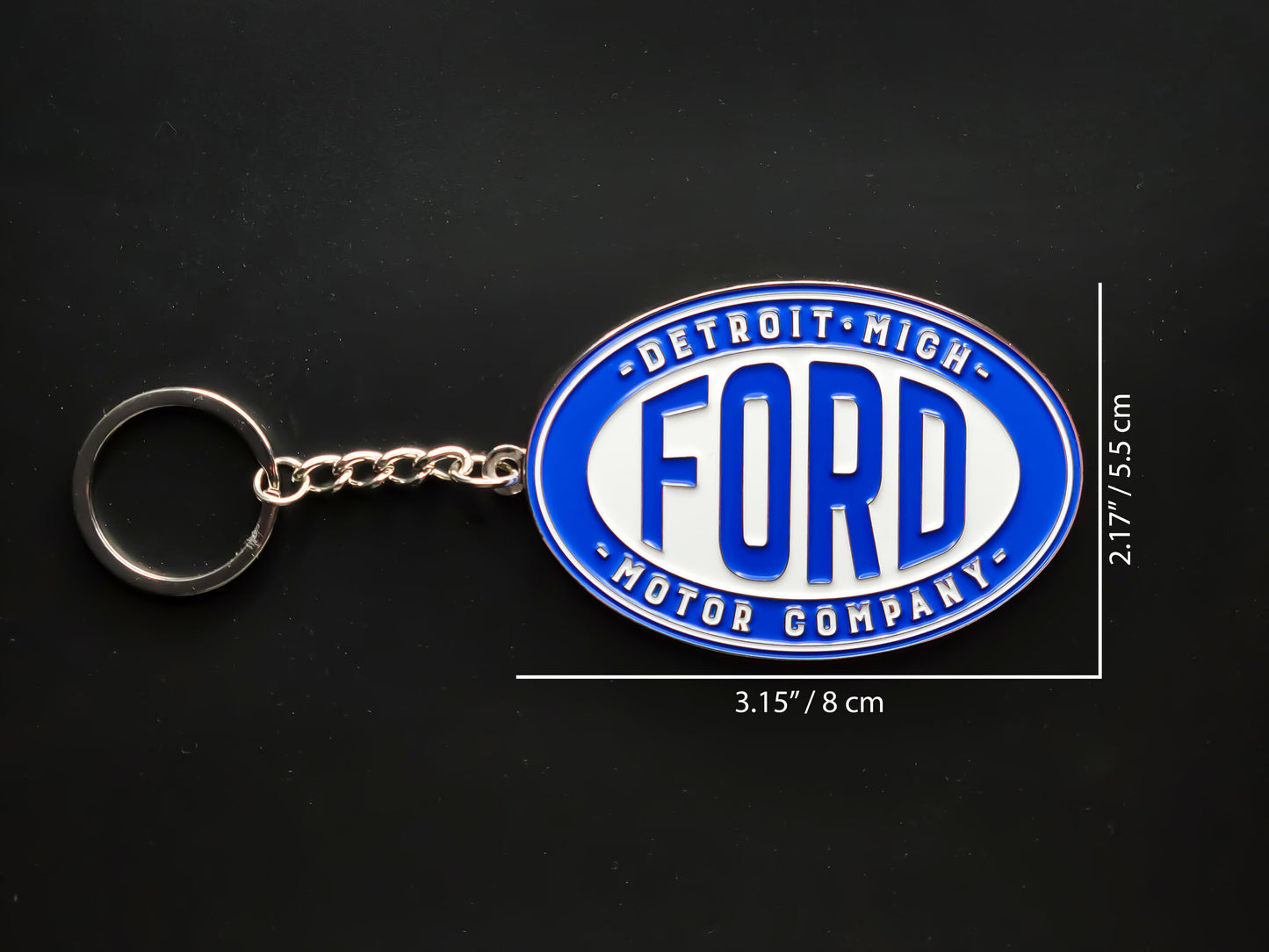
The badge in the picture is a good test: block capitals "FORD" inside an oval, with "DETROIT · MICH" above and "MOTOR COMPANY" below. None of the logo histories show that exact design on a Ford, so it gets no date here. What it does is pair the founding-era name and city with block lettering instead of the script, which makes it a handy way into the real sequence.
A 1903 badge too fussy to cast
Ford Motor Company was incorporated in Detroit on June 16, 1903, and its first car, the Model A, carried an emblem very much of its period. Swirling stems, stylized leaves and floral filigree framed a central oval, and across that oval ran the legal name: "Ford Motor Co. Detroit, Mich." Printed versions were black and white, and the usual account has the badge on the car sitting against dark green enamel.
The problem was manufacturing. Logo histories agree that the leaf work was hard to cast reliably in metal and hard to scale across printed material, so a simpler mark was needed as volume grew. (This is the Model A of 1903, not the Model A of 1927. Ford used the name twice.)
The usual fix is credited to Childe Harold Wills, Henry Ford's chief engineer and draftsman. In the standard telling he drew the cursive script around 1907, lettering it with a set of brass stencils from his grandfather, in the Spencerian penmanship American schools taught in the late 19th century. The script is said to have been registered with the US Patent Office in 1909. The year and the stencil story both rest on logo-history sites that repeat each other, so treat them as the traditional version, not archive-proven fact.

A 1903 Ford Model A, the company's first car. Ford Motor Company was incorporated in Detroit that year.

The Ford Piquette Avenue Plant in Detroit, with an early car out front. The sign over the door reads Ford Motor Co.
From a British oval to the 1927 Blue Oval
The oval has a British accent. In the usual account, the importers Perry, Thornton and Schreiber wrapped the script in an oval for UK marketing in 1907, and by 1911 a double-lined oval reading "The Famous" above and "Motor Cars" below was helping unify dealer identities across Great Britain.
Then came a detour. In 1912 Ford brought out a winged triangle in orange or royal blue, with the script beside the tagline "The Universal Car". The standard story says Henry Ford disliked its clutter and had it withdrawn. That claim is repeated everywhere and sourced almost nowhere, so hold it loosely. What is clear is that Ford went back to script in an oval, and the usual account dates a plain white oval with a thin black ring to 1917, a neutral signature for the peak Model T years.
The change that stuck came in 1927, with the Model A that replaced the Model T after 19 years. (Again: the 1927 car, not the 1903 one.) The radiator badge was blue enamel, a deep royal blue field with white script, a thick inner white ring and a thin outer contour. Blue is what turned a script in an oval into the Blue Oval, and the company has kept it ever since.

An advertisement with the winged triangle, which Ford brought out in 1912 with the tagline "The Universal Car".

A 1928 Ford Model A with the blue oval on its radiator. The blue enamel badge arrived in 1927 on the Model A that replaced the Model T.
After 1927, and the oval Paul Rand redrew
Everything later is refinement, so briefly. In 1949 and 1950 Ford put a red, white and blue crest with three gold lions on North American cars, and the company said it was adapted from an English coat of arms tied to the Ford family. That is Ford's claim, not a settled genealogy. The oval stayed on stationery and signage, and the usual account has it widened into a lozenge in 1957. Block F-O-R-D lettering stayed on vehicles through the 1960s and early 1970s, until 1976, when the Blue Oval became the standard exterior badge worldwide. That block lettering, not the script, is what the badge in the picture uses.
The best-documented episode after 1927 is the one that never happened. In March 1966 Henry Ford II consulted Paul Rand, the designer behind the identities of IBM, ABC, UPS and Westinghouse. Rand's brand book proposed a modernist script whose F crossbar swept out to form the top of an elongated oval around the whole wordmark, and he argued that turn-of-the-century calligraphy was out of step with advanced engineering. Ford turned it down. The usual explanation is that the old script was simply too well known to give up.
The oval was reworked for the 2003 centennial, later flattened for screens, and given a darker, flat-white vehicle version on the 2024 F-150. The lettering underneath still traces back to what a draftsman set down around 1907.

The crest on a 1950 Ford. Ford said it was adapted from an English coat of arms tied to the Ford family.

A page from Paul Rand's 1966 brand book for Ford. Ford turned his proposal down.

A Ford Mark IV race car on display at The Henry Ford, number 1 on the nose. The museum sign gives the year as 1967.
Ford spent the years from 1903 to 1927 working out what its name should look like, and the answer was a signature inside a blue oval. Everything since has been the same answer, redrawn.
In summary
What was Ford's original logo?
Ford's first emblem, from 1903, was an ornate Art Nouveau badge with swirling stems and leaves around an oval reading "Ford Motor Co. Detroit, Mich." It was hard to cast in metal, so simpler script-based marks soon took over.
When did Ford start using the Blue Oval?
The Blue Oval arrived in 1927 as a blue enamel radiator badge on the Model A that replaced the Model T. Before that, Ford ran its script inside plainer ovals.
Who designed the Ford script?
Childe Harold Wills, Henry Ford's chief engineer and draftsman, is usually credited, around 1907. The story that he used his grandfather's stencils is the traditional version, repeated across logo histories.
Did Ford ever try a different logo?
Yes. Ford tried a winged triangle in 1912, and in 1966 Paul Rand proposed a modernist redesign, which Henry Ford II rejected. The Blue Oval stayed.
Are there two Ford Model As?
Yes. The first Ford car of 1903 was called the Model A, and so was the 1927 car that replaced the Model T.