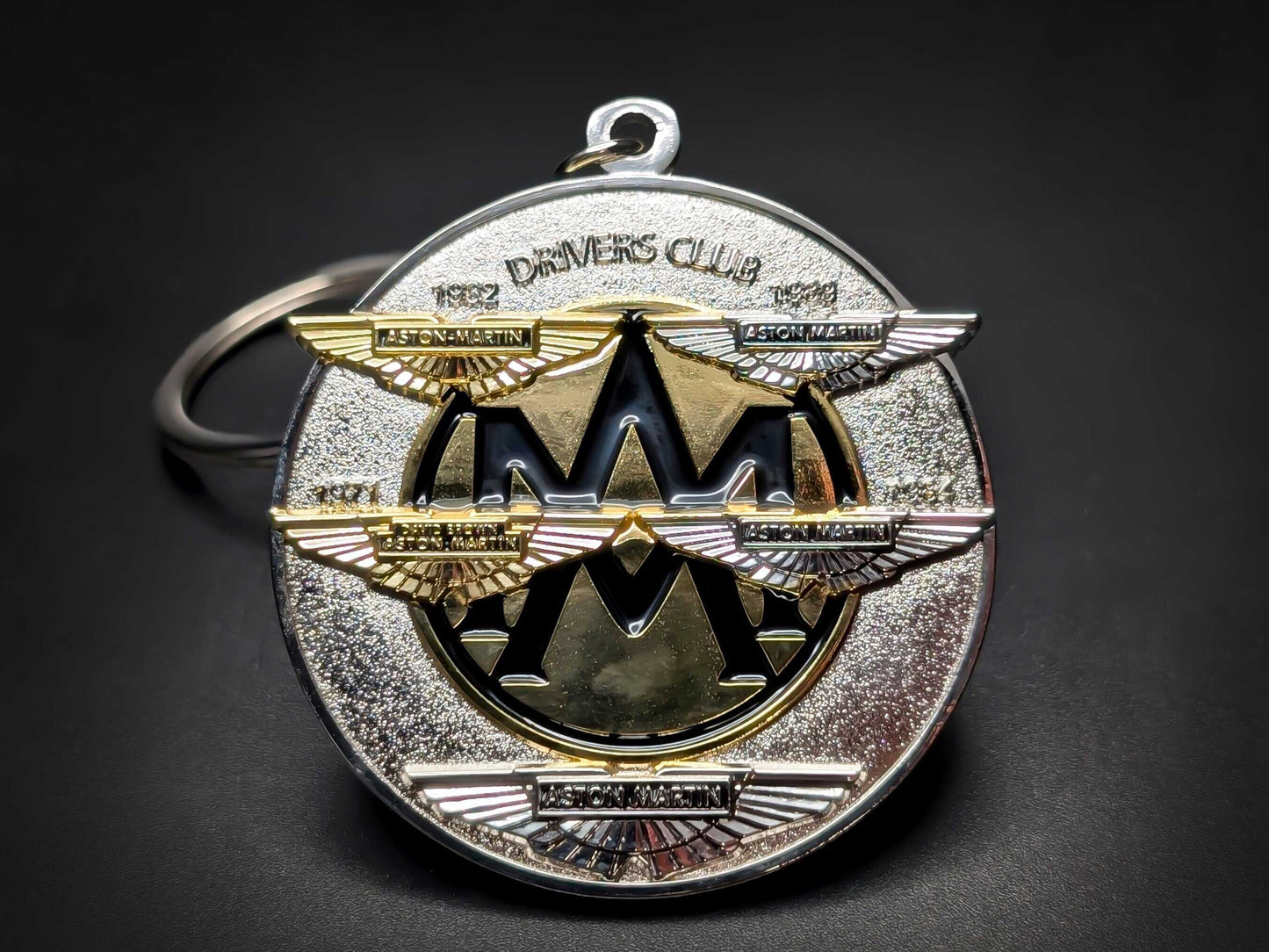
Aston Martin wings logo: the 1932 redesign that defined the badge
From Sammy Davis’s hand-drawn scarab in 1932 to Peter Saville’s 2022 digital overhaul, the Aston Martin wings emblem is a record of every ownership change and near-collapse the marque came through.
The Aston Martin wings badge has carried the same essential shape for over ninety years: a pair of flat, segmented wings flanking a dark central nameplate. That shape was not a founding vision. It arrived in 1932, after the company had already nearly died twice, drawn by a man who raced cars, edited a magazine, and trained as a draughtsman. The symbolism he embedded in it was deliberate, borrowed from ancient Egypt, and chosen for a company with a habit of coming back from the dead.

Before the wings: Kate Martin's monogram
The brand did not begin with wings. When Lionel Martin and Robert Bamford registered the Aston Martin name in 1914, following Martin's competitive run at the Aston Hill Climb in Buckinghamshire, they carried no visual identity worth recording. The first true badge arrived around 1920 or 1921, designed under the direction of Lionel Martin's wife, Kate, who was herself an active competitor at the wheel of the company's earliest cars. Kate Martin's design was a circular gold roundel, double-lined, containing an interlocking uppercase "A" and "M" monogram rendered in dark green as an explicit nod to British racing green. Clean, typographic, personal.
Count Louis Zborowski died at Monza during the 1924 Italian Grand Prix. He had been the company's primary financial patron, and his death hollowed out the budget. Lionel Martin departed. A consortium of investors rescued the business, reorganized it as Aston Martin Motors Ltd, and retired the monogram to mark the break.
The aviation years: 1927 to 1932
The first winged badge, introduced in 1927, featured detailed bronze feathered wings spread across a stylized Art Deco nameplate, the central "M" elongated so its outer bars merged with adjacent letters. The designer's name is not recorded. In 1930 the wings were swept upward into a sharper V-shape and the base metal shifted from bronze to silver. These were decorative wings, aviation-influenced shorthand for a decade saturated with transatlantic flights and the social prestige of pilots. The scarab that followed was something else entirely.
Sammy Davis and the scarab synthesis
Sammy Davis (born Sydney Charles Houghton Davis) had co-won the 1927 Le Mans 24 Hours) with Dr. Dudley Benjafield, nursing a battered Bentley to the finish after a multi-car crash, then gone on to edit The Autocar and serve as the first vice-president of the Aston Martin Owners Club. He had driven for Aston Martin's record-breaking team in 1922. He was a racing driver, a draughtsman by training, and about as far from a professional graphic designer as you could get.
Scarabaeus sacer, the beetle sacred to Khepri, the Egyptian sun god of rebirth and new beginnings, was what Davis reached for when Aston Martin came to him in 1932. Howard Carter's 1922 discovery of Tutankhamun's tomb had set off a decade of cultural Egyptomania across Europe. For a company that had already survived two near-collapses and a complete ownership change, the reference was not subtle. Davis flattened and straightened the previous swept wings, modeling the individual feather segments on the wing cases of Egyptian scarab carvings, and set a sharp black rectangle carrying "Aston Martin" in clean silver block lettering at the center. The design first appeared on the Aston Martin LM1 racing car that Davis purchased and converted to road use, then spread to all production vehicles. Every badge iteration since 1932 has been a refinement of that template, not a replacement.

The wings on a current car, segmented template Sammy Davis drew in 1932.
The David Brown years and the badge as personal signature
Sir David Brown, a Yorkshire tractor manufacturer, bought the company in 1947. His tenure produced the DB series, starting with the DB1 in 1948, and the DB5 became one of the most recognized automobiles in cinema after its appearance in the 1964 James Bond film Goldfinger. In 1950 Brown modified the badge to include his name in smaller uppercase lettering placed directly above the "Aston Martin" wordmark, putting his name on the car's face as a statement of ownership. When Brown sold the company to Company Developments Ltd in 1972, his name came off the badge immediately. Subsequent owners revised the design in 1984 and again in 2003 around the opening of the Gaydon headquarters, both times staying inside the Davis framework.
The physical badge has been handcrafted by Vaughtons, a Birmingham silversmith founded in 1819, since at least the 1970s for heritage Newport Pagnell cars. Producing a single badge requires up to roughly 100 individual treatments: copper alloy stamped at up to 600 tonnes of pressure, vitreous enamel applied by hand segment by segment using a tool resembling an oversized fountain pen, fired in a kiln at approximately 800 degrees Celsius, and electroplated so chrome deposits only on the exposed copper dividing lines, producing the characteristic raised silver borders.
The 2022 Saville rebrand: designing for a screen
Concentric intersecting lines produce visual aliasing when scaled to smartphone screens, smartwatch faces, and digital instrument clusters. That was the problem. In July 2022 Aston Martin commissioned Peter Saville, co-founder of Factory Records and the designer behind Joy Division's Unknown Pleasures cover art, to address it. The specific change he made: removing the concentric semi-circular arc that had run beneath the central nameplate and cut across the radiating feathers since the 1932 Davis original. He also thickened the outer perimeter lines, simplified the internal feather angles, and replaced the gradient green background with a solid forest green field.

The modern wings
Saville described the changes as "subtle but necessary enhancements" that allow the mark to function across new technologies without abandoning its form. The rebrand was announced alongside a £653 million capital raise that included a 16.7% stake acquisition by the Saudi Arabian Public Investment Fund. The new wings made their competitive debut at the French Grand Prix on the Aston Martin Aramco Cognizant F1 cars.
The F1 cars also wore a reproduction of Kate Martin's original button monogram on their noses, marking the 100th anniversary of the company's first Grand Prix entry. The badge that replaced the monogram in 1927 debuted in its newest form alongside a revival of the monogram it had displaced. Ninety-odd years later, the circle closed.
In summary
Why does the Aston Martin logo have wings?
The wings were added in 1927 to tap into the global aviation craze of the Roaring Twenties. A new ownership consortium had taken over the financially distressed company and used the winged badge as a symbol of speed and a clean break from the founding era, replacing the original circular monogram.
Who designed the Aston Martin wings logo?
The defining 1932 version came from Sammy Davis, a racing driver, Autocar sports editor, and trained draughtsman who modeled the flat, segmented feathers on Egyptian scarab beetle carvings. No record survives of who designed the original 1927 winged badge.
What does the Aston Martin scarab symbolize?
In ancient Egyptian cosmology, the scarab beetle stood for rebirth and new beginnings, tied to the sun god Khepri. Davis chose it deliberately for a company that had already survived two near-collapses and a full ownership change by 1932.
What did Peter Saville change about the Aston Martin logo in 2022?
Saville removed the semi-circular concentric arc that had intersected the feathers since 1932, thickened the outer perimeter lines, and swapped the gradient green background for a solid forest green field. The driving concern was digital legibility: intersecting lines cause visual aliasing at small screen sizes.
Where are Aston Martin badges made?
Since 2012, badges on all main production vehicles have been handcrafted by Vaughtons, a silversmith studio founded in 1819 in Birmingham's Jewellery Quarter. Each badge goes through up to around 100 individual treatments, including hand-applied vitreous enamel and electroplating.
What was the original Aston Martin logo before the wings?
The original badge, introduced around 1920 or 1921, was a circular gold double-lined roundel with an interlocking 'AM' monogram in dark green, created under the direction of Kate Martin, Lionel Martin's wife. It was retired in 1927 when new owners took over the company.