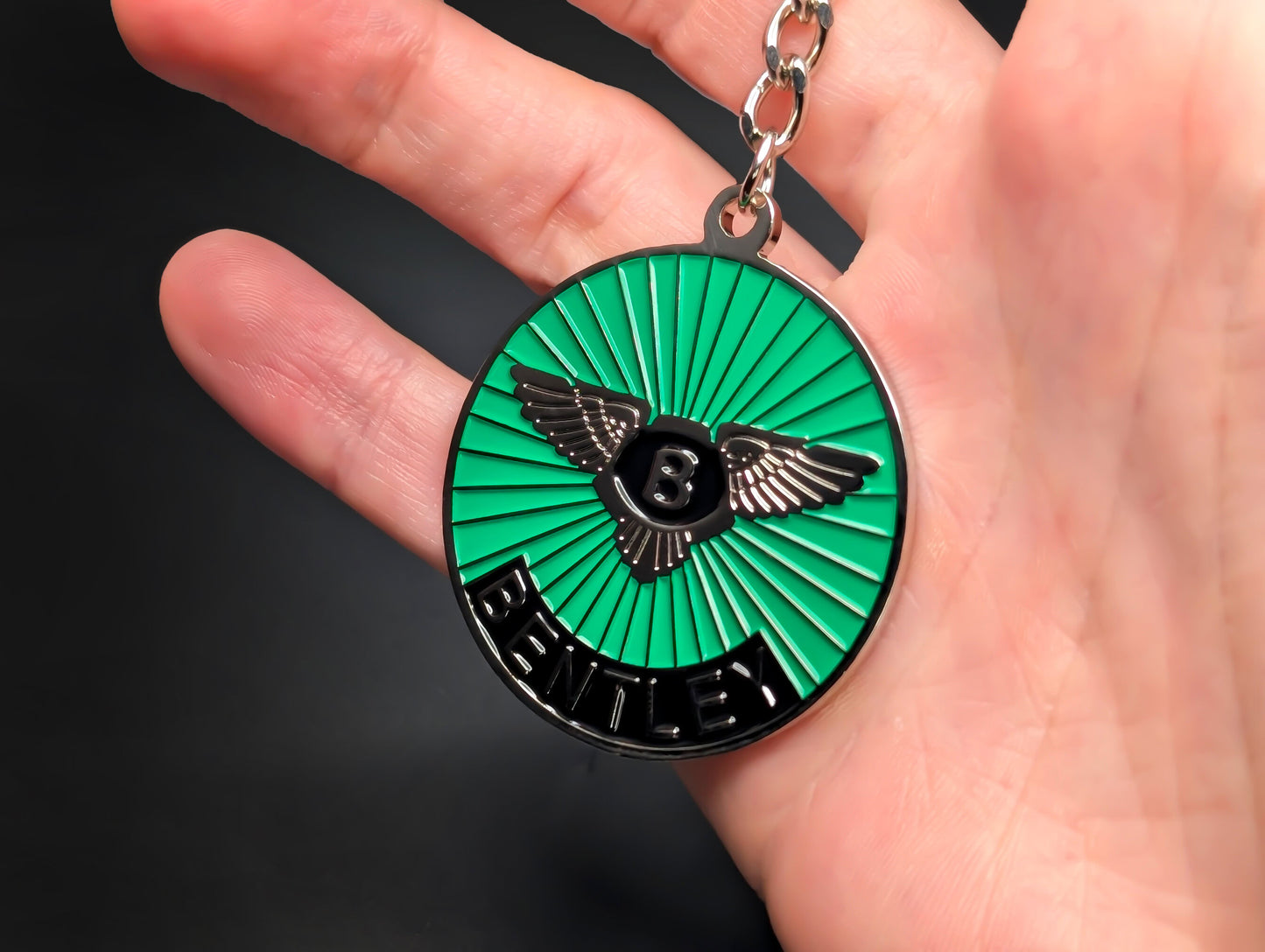
What the Bentley Winged B wings mean
The wings on a Bentley badge stand for speed and flight. The feather count is what people argue about, so here is what holds up.
The wings on Bentley's Winged B badge stand for speed and flight: Bentley says they represent the exhilaration of motion, and perhaps W.O. Bentley's First World War work on fighter-plane engines. F. Gordon Crosby, a motoring artist and illustrator for The Autocar, drew the badge in 1919 and gave each wing a different number of feathers. Bentley says he did it to make the badge unique and stay ahead of fraudulent imitations. On the version introduced in 2002, that means ten feathers on the left and eleven on the right.
Count the feathers on a Bentley badge and the two sides refuse to agree. That is the detail enthusiasts love to repeat, and it usually arrives with a story about forgers attached. Unusually for badge lore, that story comes from the maker itself. The simpler question underneath it is older: why wings at all?
Wings for speed, and for W.O.'s aero engines
Walter Owen Bentley founded the company on July 10, 1919, and Bentley's own history pages record that he had spent the war designing aircraft engines, the BR1 and BR2 rotaries. Bentley today says the wings were chosen to represent "the exhilaration of motion," and adds, with a careful "perhaps," that they may also point back to those fighter-plane engines. The aero link is the reading most people give the badge, but even the company stops short of claiming it outright.
Crosby, a motoring artist, was the right hand for the job. He spent his working life drawing for The Autocar, and the trick of that trade is making a standing car look like it is already moving. A capital B in a dark oval with a wing spread on either side does exactly that in one compact shape.
The racing record gave the wings their weight. Bentley won the 24 Hours of Le Mans in 1924, then took it every year from 1927 to 1930. A badge with wings on cars that kept finishing first needed very little explaining. The company had been founded in Cricklewood, London, only five years before the first win, and the badge carried that early racing reputation onto every road car that followed.

A Bentley-designed rotary aero engine. W.O. Bentley spent the war designing aircraft engines, the BR1 and BR2 rotaries.

A 1929 Bentley 4.5 Litre Le Mans car. Bentley won Le Mans in 1924, then every year from 1927 to 1930.
Ten feathers on the left, eleven on the right
Bentley gives no count for Crosby's 1919 original, only that the two wings differed. After Rolls-Royce bought Bentley in 1931, the badge was redrawn symmetrical, with ten straightened feathers on each side flanking a simpler B in a plain black oval. The uneven wings came back on the version introduced in 2002 with the Continental GT: ten feathers on the left and eleven on the right, as a tribute to the original. Motor1's history of the badge follows the wings through each of those changes.
Why make the wings unequal? Bentley's own 2025 release answers plainly: Crosby gave each wing a different number of feathers "to make it completely unique" and to "stay one step ahead of fraudulent imitations." A copyist working from a tidy symmetrical drawing would give himself away. It is a rare piece of badge lore that the maker tells about itself, though the account comes a century after the drawing and the release does not point to a 1919 document behind it.
That same release announced the most recent change, on July 1, 2025, a week before the badge's first appearance on the EXP 15 concept car. In it, design director Robin Page called it "only the fourth evolution" of the Winged B, though some outlets called it the fifth logo. The lower feathers are gone, the wings take a sharper shape from the peregrine falcon, and the inner feathers get a faceted, diamond-like pattern. The central B was reworked with watchmaking details, a bevelled glass edge and a chamfered metal surround, so it can also stand on its own without the wings.

A Bentley Winged B badge with the flying B mascot behind it. The uneven wings returned on the version introduced in 2002.

The new Winged B on the EXP 15 concept. Bentley revealed it on July 1, 2025, with sharper wings and no lower feathers.
Red, green and black: a loose convention
The colour behind the B reads better as a habit than a rule, and it had exceptions. A buyer could not simply decode a car from its badge, but a few pairings are well documented.
The firmest example is the Arnage, which was sold in Green Label and Red Label versions. The Arnage entry on Wikipedia notes that the Red Label used the 6.75-litre turbocharged V8. Black badges are associated with the most performance-focused cars, such as the Continental T. Green ties back to the British racing green of the 1920s Le Mans cars, a link made in a Rolls-Royce Silver Spirit club write-up on the Continental R.
So the wings mean motion, the fighter-plane engines are a "perhaps," and the uneven feathers are the one part Bentley explains outright: Crosby's 1919 answer to forgers. Next time you count ten on one side and eleven on the other, you are looking at an anti-copying idea the company still tells a century later.
In summary
What do the wings on the Bentley badge mean?
The wings stand for motion and speed; Bentley says they were chosen to represent the exhilaration of motion. The company adds that they may also nod to its founder's First World War work on fighter-plane engines, the BR1 and BR2 rotaries.
How many feathers are on each side of the Bentley Winged B?
The version introduced in 2002 has ten feathers on the left and eleven on the right. The Rolls-Royce-era badge from 1931 had ten on each side, and Bentley gives no count for the 1919 original beyond saying the wings differed.
Why does the Bentley badge have uneven wings?
Bentley says Frederick Gordon Crosby gave each wing a different number of feathers to make the badge unique and stay one step ahead of fraudulent imitations. A forger copying it with symmetrical wings would give himself away.
Who designed the Bentley Winged B?
Motoring artist Frederick Gordon Crosby, who illustrated for The Autocar, is credited with drawing it. Bentley was founded on July 10, 1919.
What do the Bentley badge colours mean?
Red, green and black behind the B work as a loose convention rather than an official code. The Arnage came in Green Label and Red Label versions, and black is linked to performance models such as the Continental T.