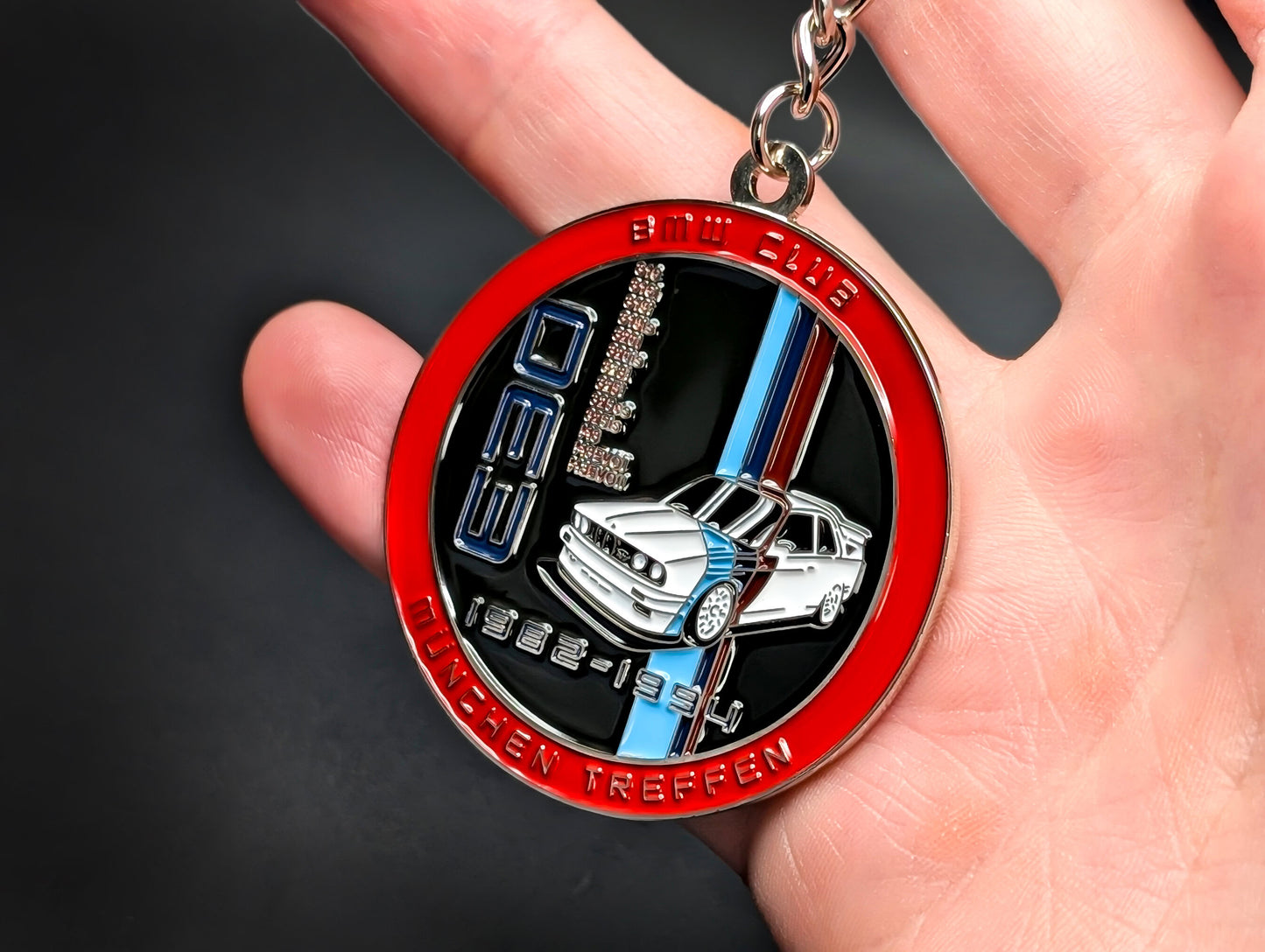
BMW E30: The Design That Built a Cult of Owners
The BMW E30 won on styling, motorsport, and a decade of owners who refused to leave it alone.
The BMW E30 3 Series, built from 1982 to 1994, became a benchmark because three things lined up at once. Chief stylist Claus Luthe drew a shape that read as restrained in 1982 and aged well past 1994. A motorsport program produced the E30 M3 as a direct answer to the Mercedes-Benz 190E 2.3-16V, and that homologation special proved so dominant on track that it defined the era. The ordinary sedan's simple rear-wheel-drive chassis proved just as durable, adaptable enough that owners kept reinventing it decades after BMW stopped making it.

Rear view of a red BMW E30 M3
BMW's own club culture still calls the car by its internal chassis code instead of a model name, and that habit says something about how the E30 built its following. Owners built the reputation lap by lap, panel by panel, and swap by swap, never off a tagline. It happened across a decade when BMW had to prove the 3 Series was worth the money against Mercedes-Benz, and then prove it again once depreciation turned the E30 into whatever its next owner needed it to be.
A shape drawn with math, not just a pencil
Claus Luthe took over as BMW's design director in 1976, succeeding Paul Bracq, and he brought a habit that was unusual for a stylist at the time: he fed engineering mathematical coordinate data straight off the design surface instead of handing over a plaster model and a shrug. Development of what became the E30 started that same July, the design was approved in 1978, and the surfaces were locked by 1979. The result read as restrained even next to BMW's own outgoing E21. BMW's 3 Series archive lists the E30's drag coefficient at 0.38 on standard models, down from an estimated 0.42 to 0.44 on the E21, and as low as 0.33 on the M3's reworked body.

The red road car and the white Group A racer share the same S14 four-cylinder, the engine Paul Rosche built from an M10 block and a shortened M88 head.
The glass sat flush and the wedge was subtle: none of it read as a gimmick, and BMW left the car alone stylistically for five full years before the September 1987 Frankfurt update swapped chrome trim for body-colored plastic bumpers, enlarged the taillights, and quietly upgraded the factory rustproofing. Luthe's own record includes the NSU Ro 80, a car whose 0.35 drag coefficient was startling in 1967, so the E30's aerodynamic discipline was a habit Luthe carried across projects, not an accident of this one.
Built to beat the 190E
None of that design restraint would have made the E30 famous on its own. What did was a fight BMW did not start. Mercedes-Benz spent more than £600 million developing the compact W201, and when the Cosworth-built 190E 2.3-16V launched in 1983 as a clear threat on the touring-car stage, BMW chairman Eberhard von Kuenheim and motorsport director Wolfgang-Peter Flohr ordered a homologation special of their own: build and sell 5,000 road cars sharing the race version's engine block, cylinder head, suspension geometry, and body silhouette, inside twelve months.

Touring car grids worldwide filled with E30 M3s through the late 1980s
Paul Rosche, BMW's motorsport technical director, reportedly sketched the answer, the S14 engine, in about two weeks. He took the cast-iron block from the humble M10, the same architecture underpinning BMW's championship-winning Formula 1 engines, and topped it with a shortened version of the M88 twin-cam, four-valve head from the M1 supercar. The street version ran individual throttle bodies and 10.5:1 compression for 195 PS; early racing versions reached as much as 300 hp at 8,200 rpm. BMW changed nearly every body panel on the M3 except the hood and roof, raising the trailing edge of the decklid by 41 millimeters to cut rear-axle lift by more than 60 percent.
It worked immediately. BMW's own retrospective credits the M3's 1987 debut season with three touring car titles in one year. Roberto Ravaglia took the World Touring Car Championship, Winfried Vogt won the European Touring Car Championship, and Eric van de Poele won the DTM. Two years on, in 1989, the car finished 1-2 at the 24 Hours of Nürburgring, a result Ate Up With Motor's history of the car treats as the moment the M3 stopped being an underdog and started being the touring car to beat.
A platform that refused to stay one thing
The ordinary E30 built a following the M3 never touched, and it did it partly by accident. In 1984, BMW prototype engineer Max Reisböck wanted a wagon and BMW did not build one, so he bought a wrecked 323i sedan, spent about $13,000 and six months in a friend's garage, and built one himself, grafting in rear glass from a Volkswagen Passat and side windows trimmed from a two-door E30 while keeping the sedan's Hofmeister kink intact. When he showed it to BMW's board, BMWBLOG's interview with Reisböck quotes his supervisor's verdict after a half-hour inspection: 'This vehicle is no longer leaving BMW.' The company put the Touring into production within three months and built more than 104,000 of them between 1987 and 1993.
Because the standard M3 was left-hand-drive only, BMW South Africa's Rosslyn plant built its own answers for a right-hand-drive market. The 333i, developed with Alpina, shoehorned the 7 Series' 3.2-liter 'Big Six' into the engine bay so tightly that buyers had to choose between air conditioning and power steering; only 204 were built. The 325iS, nicknamed 'Gusheshe,' meaning 'the quick one,' fared better: a name Hagerty's history of the 333i notes entered everyday South African speech well beyond car culture.

The E30’s shape held up in every body style BMW put it in — here the M3 convertible
That same improvisation carried the E30 into its second life. As values fell through the late 1990s and 2000s, the four-cylinder chassis became a default canvas for engine swaps, drift builds, and grassroots racing, eventually formalized as Spec E30, a parity class built around the stock 2.5-liter M20 engine that grew into one of the largest amateur road racing series in North America.
A four-cylinder 318is with a lightweight M42 up front still gets cited by owners as the more balanced car than its six-cylinder siblings, decades after anyone was cross-shopping it against a Mercedes. That's not nothing. The wagon conversions, the Rosslyn shoehorn jobs, and the Spec E30 grids would count for less if the ordinary chassis underneath them wasn't also just fun to drive badly, which is its own kind of achievement.
In summary
What does E30 stand for on a BMW?
E30 is BMW's internal chassis code for the third-generation 3 Series, built from 1982 to 1994, not a trim name or marketing label. BMW enthusiast clubs still use the code as shorthand instead of a model year range.
Why was the BMW E30 M3 built?
BMW built the E30 M3 to homologate a race car for Group A touring car competition, specifically to counter the Cosworth-engined Mercedes-Benz 190E 2.3-16V, which Mercedes had launched in 1983 to compete in the same series. Group A rules required BMW to build at least 5,000 road-legal examples sharing the race car's engine block, cylinder head, suspension geometry, and body silhouette within twelve months.
What engine is in the BMW E30 M3?
The E30 M3 uses the S14, a four-cylinder engine BMW's Paul Rosche built by combining the cast-iron block from the M10 with a shortened version of the M88 twin-cam head from the M1 supercar. In catalyzed street trim it produced 195 PS, while the later 2.5-liter Sport Evolution version reached 238 PS.
Did BMW make an E30 wagon?
Yes, the E30 Touring, though it started as an unofficial project. BMW prototype engineer Max Reisböck built the first one himself in a friend's garage in 1984, and BMW put it into production within three months after seeing it. Production ran from 1987 to 1993 and totaled more than 104,000 units.
What is the BMW 325iS Gusheshe?
The 325iS 'Gusheshe' was a South Africa-only performance variant of the E30 built for Group N racing, developed because the standard left-hand-drive-only M3 could not be sold in that right-hand-drive market. Its nickname means 'the quick one' and became common South African slang beyond car culture.
Why are BMW E30s valuable today?
Collector interest in the E30, especially the M3, rests on motorsport pedigree, a rear-wheel-drive chassis that still feels engaging to drive, and a grassroots racing scene built around the stock chassis. Well-preserved M3s and Sport Evolution models now regularly draw six-figure prices at auction.