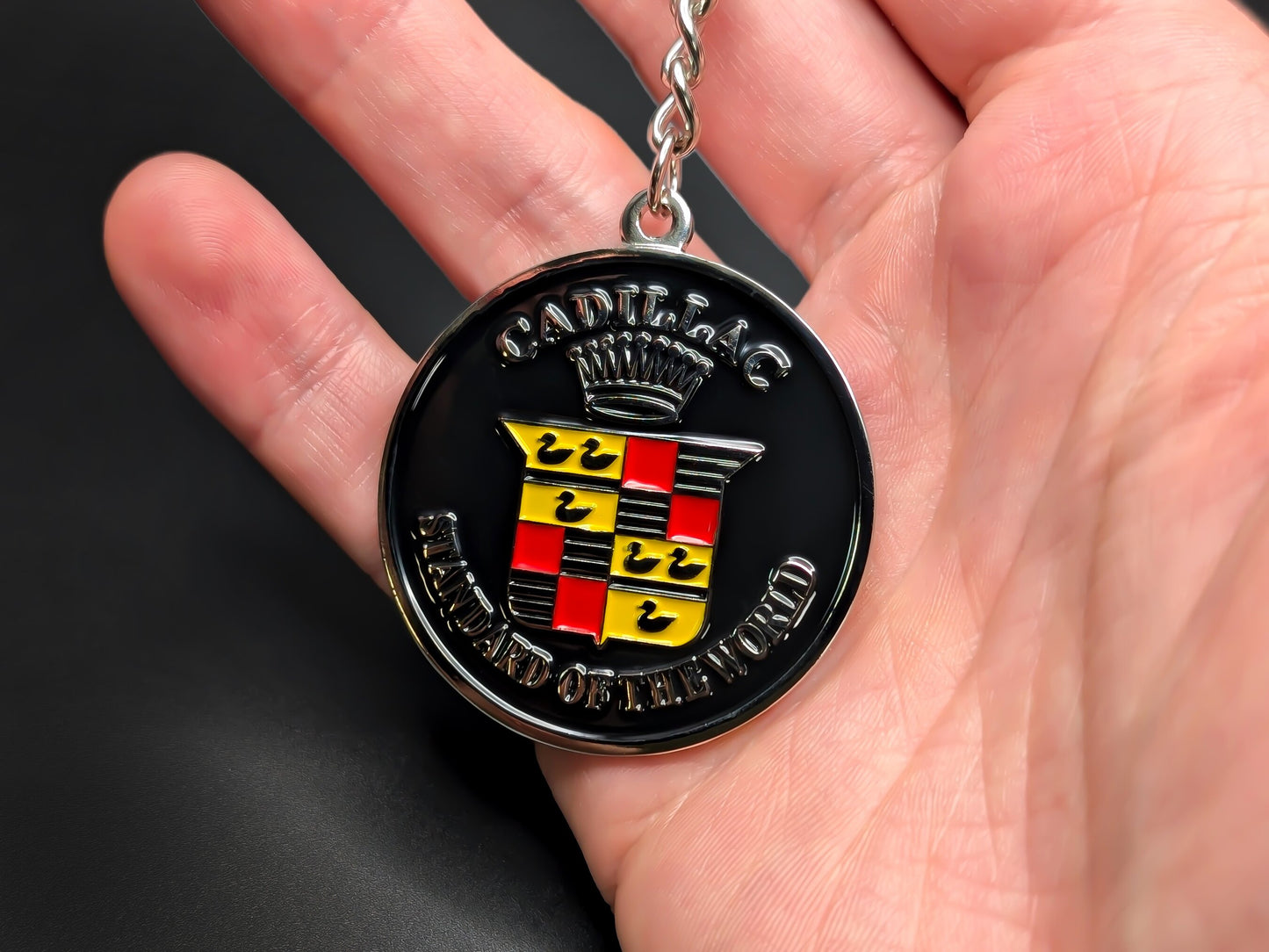
The 1908 Test Behind Cadillac’s Standard of the World
A 1908 test in England broke three Cadillacs down to 2,163 parts, then rebuilt them using only hand tools. That test produced Cadillac’s most famous slogan.
Cadillac earned its Standard of the World slogan from a two-week trial at England's Brooklands race track in early 1908. The Royal Automobile Club tore down three stock Cadillac Model K runabouts into 2,163 parts, scrambled them, swapped in 89 random replacement components, and had two mechanics rebuild all three using nothing but hand tools. All three cars then ran a 500-mile endurance test and lost a single scoring point, for a broken cotter pin. The Royal Automobile Club awarded Cadillac the 1908 Dewar Trophy, and the company put the phrase on its advertising the following year.
The stunt had a point to prove, and luxury wasn't it. British and European coachbuilders had spent the first decade of the twentieth century treating American interchangeable-parts manufacturing as a shortcut, a way to build cars fast and cheap by skipping the hand-fitting real craftsmen did on the Continent. Henry Leland, the machinist who rebuilt a failed Detroit car company into Cadillac in 1902, had spent his career arguing the opposite: that a part machined to an exact tolerance wasn't a compromise, it was the whole point of modern manufacturing. Brooklands is where he got to prove it in public, with RAC officials as witnesses and no room to cheat.
The machinist who wouldn't file a part by hand
By way of New England's precision-tool trade, Leland came to Detroit. He apprenticed at Brown & Sharpe in Providence, Rhode Island, then worked in the firearms industry at Colt, where a part that didn't fit meant a rifle that wouldn't cycle. That grounding in the American System of Manufacturing shaped everything he built afterward. When investors hired him in 1902 to appraise the wreckage of the Henry Ford Company, he told them the tooling was worth more running than scrapped, and the reorganized company was renamed for Antoine de la Mothe Cadillac, the French officer who founded Detroit in 1701. The standard Leland wanted survives in a line long attributed to him: "We must make every piston so exact, and every cylinder so exact that every piston will fit into every cylinder." That sentence, not a marketing brief, was the actual design target for the car Cadillac would eventually put in front of the Royal Automobile Club.

The motto cast into the hardware: a "Standard of the World" hub cap on an early Cadillac.
Three cars, 2,163 parts, one storm
Frederick Stanley Bennett, Cadillac's importer in the United Kingdom, made the test happen. Tired of hearing British manufacturers dismiss American cars as mass-produced approximations, he challenged the Royal Automobile Club to run a standardization trial and publish whatever it found. The RAC agreed. On February 29, 1908, three stock 1907 Model K runabouts, wearing the registration plates A2EO, A3EO, and A4EO, were driven a preliminary fifty miles to Brooklands and then locked away untouched. Three days later, on March 2, RAC officials tore all three down to 721 parts apiece, 2,163 in total, scrambled the pile, and swapped in 89 replacement parts pulled at random from ordinary dealer stock. Mechanics E. O. Young and M. M. Gardner rebuilt all three cars using wrenches, screwdrivers, hammers, and pliers only, with no filing and no hand-fitting allowed.
A storm flooded the shed where the parts sat overnight, and the crew cleaned the submerged components with nothing but dry, oily rags before finishing the job. All three cars started on the first attempt and ran a mandatory 500-mile endurance test at Brooklands, finishing on March 13 without failure and losing a single scoring point to a broken cotter pin on an ignition lever. The Royal Automobile Club awarded Cadillac the Dewar Trophy for 1908, the era's top prize for automotive engineering achievement, and Cadillac put Standard of the World on its advertising the following year.
A second trophy, and a slogan built to be attacked
Henry Leland's friend Byron Carter, founder of the Cartercar company, died in 1908 after a hand crank backfired and shattered his jaw while he was helping a stranded driver on Detroit's Belle Isle Bridge. Leland, furious at a danger built into every gasoline car on the road, challenged Charles Kettering to build a practical electric starter, and the resulting Delco system debuted on the 1912 Cadillac Model Thirty. It won Cadillac a second Dewar Trophy in 1912, four years after the first, putting the company among the very few marques ever to take the award twice.
By 1915, that record was under attack. Rivals were pointing at early short circuits and fuel-line fires in Cadillac's new V8 to question the company's engineering claims. Cadillac's advertising counsel, Theodore F. MacManus, answered not with a technical rebuttal but with a single unsigned essay, "The Penalty of Leadership," published in The Saturday Evening Post on January 2, 1915. Its central line borrowed the company's own slogan and turned criticism into proof: "When a man's work becomes a standard for the whole world, it also becomes a target for the shafts of the envious few." The ad ran once. Cadillac kept fielding requests to reprint it for the next thirty years.
In summary
What is the story behind Cadillac's Standard of the World slogan?
Cadillac earned the phrase after a 1908 test at England's Brooklands circuit. The Royal Automobile Club tore down three Model K Cadillacs into 2,163 parts, threw in 89 random replacement parts, and had mechanics rebuild them with nothing but basic hand tools. All three cars then ran 500 miles without issue, and Cadillac adopted the slogan in 1909.
Why did the Royal Automobile Club test Cadillac's cars in 1908?
Cadillac's UK importer, Frederick Stanley Bennett, wanted an independent body to verify that interchangeable parts could match hand-fitted craftsmanship, because British buyers were skeptical of American manufacturing. The RAC agreed to run the standardization trial and publish the results.
What did Cadillac win for the Brooklands test?
The Royal Automobile Club awarded Cadillac the 1908 Dewar Trophy, the top prize of the era for automotive engineering. Cadillac won the trophy again in 1912 for the Delco electric self-starter, one of very few marques ever to win it twice.
Who was Henry Leland?
Henry Leland was the machinist and engineer who founded Cadillac in 1902, using assets from the failed Henry Ford Company. He had trained in firearms manufacturing at Colt, and that background is why he insisted on parts precise enough to swap between cars without hand-fitting.
What is The Penalty of Leadership?
It's a 1915 advertisement that Cadillac's ad counsel, Theodore F. MacManus, wrote to defend the brand against critics of its new V8 engine. Rather than answer the technical complaints directly, it argued that criticism was the price of setting a standard others measured themselves against.