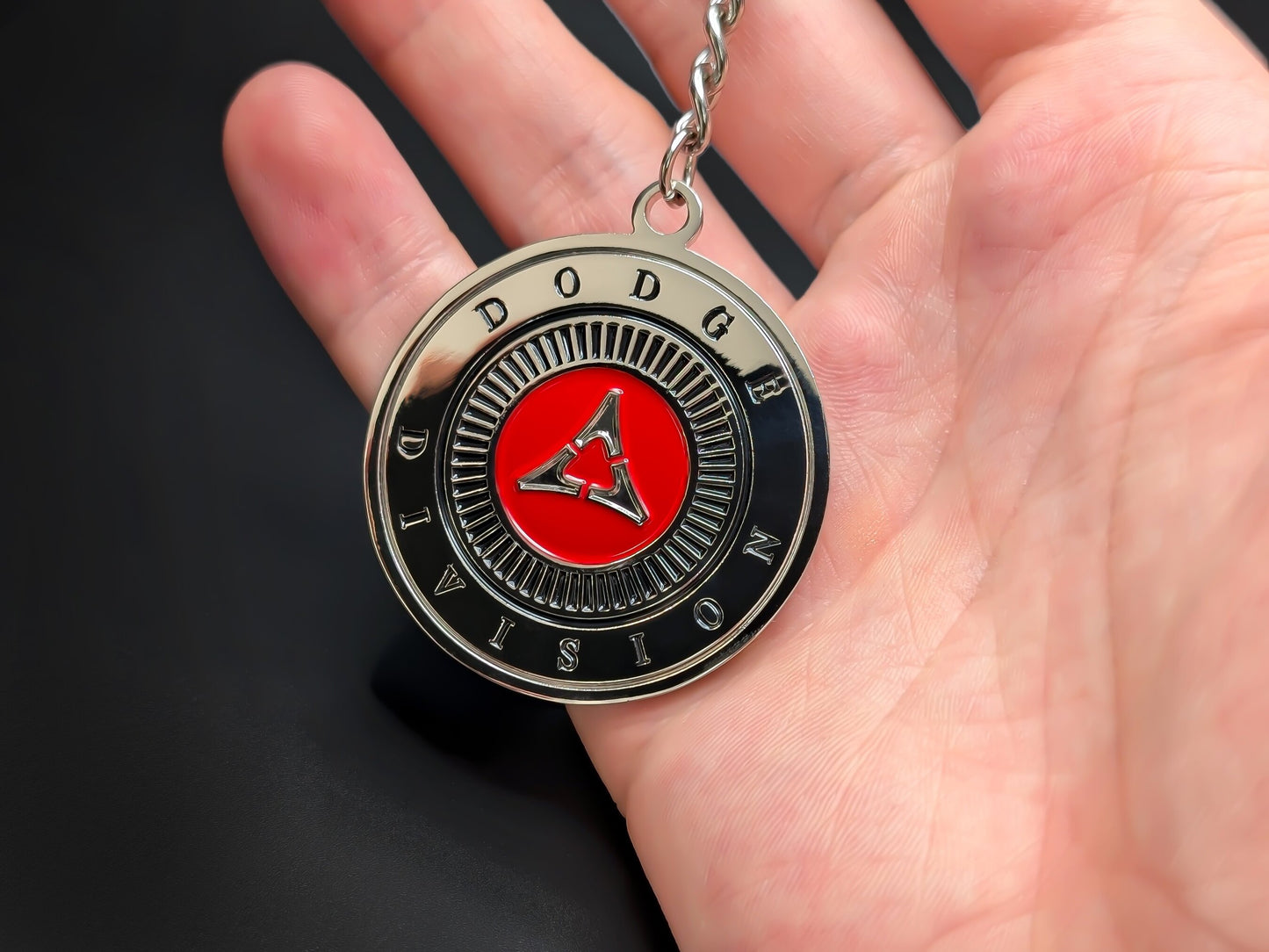
The Fratzog: Dodge’s real geometry, made-up name
The iconic Fratzog first appeared on a 1962 Polara grille. Sixty years later it came back as the illuminated badge on a 2024 electric Charger and is still going strong.
The Dodge Fratzog is a three-arrowhead geometric emblem introduced in 1962 on the Polara 500 and Custom 880, phased out of Dodge production by 1976, and revived in 2024 as the badge of Dodge's electrified eMuscle vehicles. Its name was coined on the spot by a designer who had no better answer when corporate pressed him, and the team never replaced it. The geometry is not arbitrary: the shape is a deltoid curve, a three-cusped hypocycloid, split into three outward-pointing arrowheads. For fourteen years it appeared on select Dodge models in a pattern nobody has fully explained.
Heraldic, geographic, classical Latin: the usual sources when an automotive logo needs a name. The Fratzog's backstory skips all of that. A designer was pressed by marketing for a name, offered the first word that came to him, and when the team couldn't improve on it, the word stuck. A nonsense name wrapped around rigorous geometry, applied selectively across fourteen years of Dodge production, makes the Fratzog one of the stranger objects in Mopar iconography.

The classic Fratzog as a physical ornament, here on a mid-1960s Dodge decklid.
A gibberish name for a precise shape
Trace a point on a small circle rolling inside a circle three times its size and you get a deltoid curve, a three-cusped hypocycloid. Split that continuous mathematical trace into three discrete arrowheads pointing outward and you have something that reads simultaneously as a star, a three-bladed turbine, and a hard mechanical badge. The design team had geometry. Hemmings documented the rest: a designer pressed by the corporate marketing department offered "Fratzog" without any underlying meaning, the team could not produce a better option, and the word was adopted. No etymology, no acronymic root, no linguistic precedent in any language that researchers have identified. The name is improvisation around a shape that is not.
The emblem debuted in late 1962, replacing the "Flookerang": Virgil Exner's paired-boomerang logo from the "Forward Look" era that had appeared on ignition keys, decorative trim, and print advertisements from 1957 through 1961. DodgeGarage frames the shift as a deliberate move toward cleaner industrial geometry as the tailfin aesthetic ran out of road.
Applied selectively, explained by no one
On the 1968 Dodge Charger, the emblem sat on the front grille and vanished from the Charger line entirely the following year, according to Top Speed. On the 1970 Challenger, placement depended on trim level: the base slant-six model wore it on the front center of the hood; the performance-oriented R/T embedded it in the interior door panel wood appliques; the luxury SE mounted it as a metallic C-pillar badge beneath the vinyl roof. The Fratzog's fourteen-year run from 1962 to 1976 looks, in the catalog record, like a series of one-off decisions: three positions on one model, no reappearance on the next.
Where the Flookerang ran through print advertising from 1957 to 1961 as a graphic presence, the Fratzog rarely appeared in marketing materials at all. It was a physical ornament: grille badge, steering wheel horn button, decklid emblem, wheel cover detail. Mopar enthusiast communities have spent decades building catalogs of which model years on which trims carried the logo and where. The honest answer to "why those cars and not others" is that the planning documentation, if it ever existed, has not surfaced.
Rockets, arrowheads, and 1962
The Fratzog's commercial debut was not accidental. The launch of Sputnik in 1957 had catalyzed a massive national engineering effort, and by 1962, Chrysler Corporation was not a spectator. The company's Space Division, directed by engineering head Vaino Jack Vehko at the Michoud Assembly Facility in Louisiana, was a primary NASA contractor building the first-stage (S-IB) booster for the Saturn IB program. That booster clustered eight Redstone-derived propellant tanks, four holding liquid oxygen and four holding RP-1, around a central Jupiter-derived tank. It generated 1.6 million pounds of thrust at launch. The official Stellantis historical record documents the program's scope and scale. The Saturn IB put Apollo 7 into orbit in October 1968, carrying Walter Schirra, Donn Eisele, and Walter Cunningham on the first crewed Apollo mission.
Chrysler engineers working on rocket propulsion at Michoud were the same corporate family that had signed off on the badge. A three-pointed deltoid emblem on a Dodge grille carried a different kind of charge in that environment. The segmented arrowhead geometry read as a visual connection to rocket engineering at a time when the most visible American engineering achievement was a cluster of metal tubes pointing skyward. It gave a car grille badge a referent that most automotive logos never acquire, whether the connection was intentional at the designer level or simply absorbed from the surrounding engineering culture.
The eMuscle revival
In 2022, Dodge announced the Fratzog would return as the exclusive emblem for its electrified vehicle line. Tim Kuniskis, Dodge Brand CEO at Stellantis, described the revival as a deliberate return to the brand's own past: "something that Doc Brown would have done... very futuristic and electrified, and it's our history, which is what we do." On July 12, 2022, FCA US LLC filed trademark application serial number 97499019 for the modern three-dimensional Fratzog, defined in the filing as "a split deltoid made of three arrowhead shapes that form a three-pointed star," registered for use on passenger automobiles. Edmunds covered the announcement and the trademark's implications in detail.

The revival. The 2024 Dodge Charger Daytona carries an illuminated LED Fratzog at the center of its front light bar, the 1960s emblem reborn as the badge of Dodge’s electric eMuscle line.
The 2024 Dodge Charger Daytona, built on the STLA Large platform, carries the logo in white LED at the front and red LED at the rear. The Scat Pack variant produces 670 hp and reaches 60 mph in 3.3 seconds. A patent-pending Fratzonic Chambered Exhaust routes synthetic low-frequency tones through a rear tuning chamber and amplifier to produce 126 dB of acoustic output, matching the decibel level of a supercharged SRT Hellcat V8. The choice to revive a 1962 geometric emblem rather than commission something new raises a question the trademark filing cannot answer on its own: whether the Fratzog belongs to a specific era of Dodge engineering, or to the harder geometry of speed itself.
The Fratzog disappeared from Dodge's cars by 1976 with no announcement. It returned in 2022 with a trademark filing and an EV reveal. Nearly half a century of dormancy apparently did not diminish what the shape communicates.
In summary
What is a Fratzog?
The Fratzog is a three-arrowhead geometric emblem Dodge used from 1962 to 1976, derived from a deltoid curve, specifically a three-cusped hypocycloid. A designer made the name up on the spot; it has no meaning. Dodge revived the emblem in 2022 as the exclusive badge for its eMuscle EVs.
Why is the Dodge logo called a Fratzog?
The name has no etymology. A Dodge designer came up with it on the spot when management pressed him for a name, and the team never found a replacement. Both Dodge's official account and Hemmings confirm the word was gibberish.
What does the Fratzog symbolize?
The Fratzog's geometry comes from a deltoid curve, a three-cusped hypocycloid, which gives it a defined mathematical structure despite the accidental name. In its 1962 debut, the hard-edged arrowhead shape fit the space-age design vocabulary, at a time when Chrysler's Space Division was building Saturn IB rocket boosters for NASA. What the designer intended it to symbolize is not on record.
What cars had the Fratzog emblem?
The Fratzog appeared on Dodge models from 1962 through 1976, including the Polara 500 and Custom 880 at debut, the 1968 Charger on its front grille only, and the 1970 Challenger in different locations depending on trim level. Its use across the lineup was inconsistent, and Dodge never explained which models were supposed to get it.
When did Dodge bring back the Fratzog?
Dodge revived the Fratzog in 2022. On July 12, 2022, the company filed trademark application serial number 97499019, covering a three-dimensional LED version described as a split deltoid of three arrowhead shapes forming a three-pointed star. The emblem appears on the 2024 Dodge Charger Daytona as the exclusive badge for Dodge's eMuscle EVs.