Tokyo Sports Car Club: the airbase roots of JDM gymkhana
American airmen at Tachikawa Air Base pioneered gymkhana in Japan. And to this day, their enamel badge still gets traded at midnight.
The Tokyo Sports Car Club was founded in the mid-1950s by United States Air Force personnel at Tachikawa Air Base, west of Tokyo, and by around 1956 it was headquartered in Hangar 5, a converted aircraft hangar on the flightline. It was a military-civilian club that pioneered gymkhana, the cone-course autocross discipline, on disused airbase concrete, and its red-and-gold enamel badge later became a prized symbol of belonging in Japan's classic-car and street-racing scenes. It is a separate organization from the earlier Sports Car Club of Japan, the national body it is often confused with.

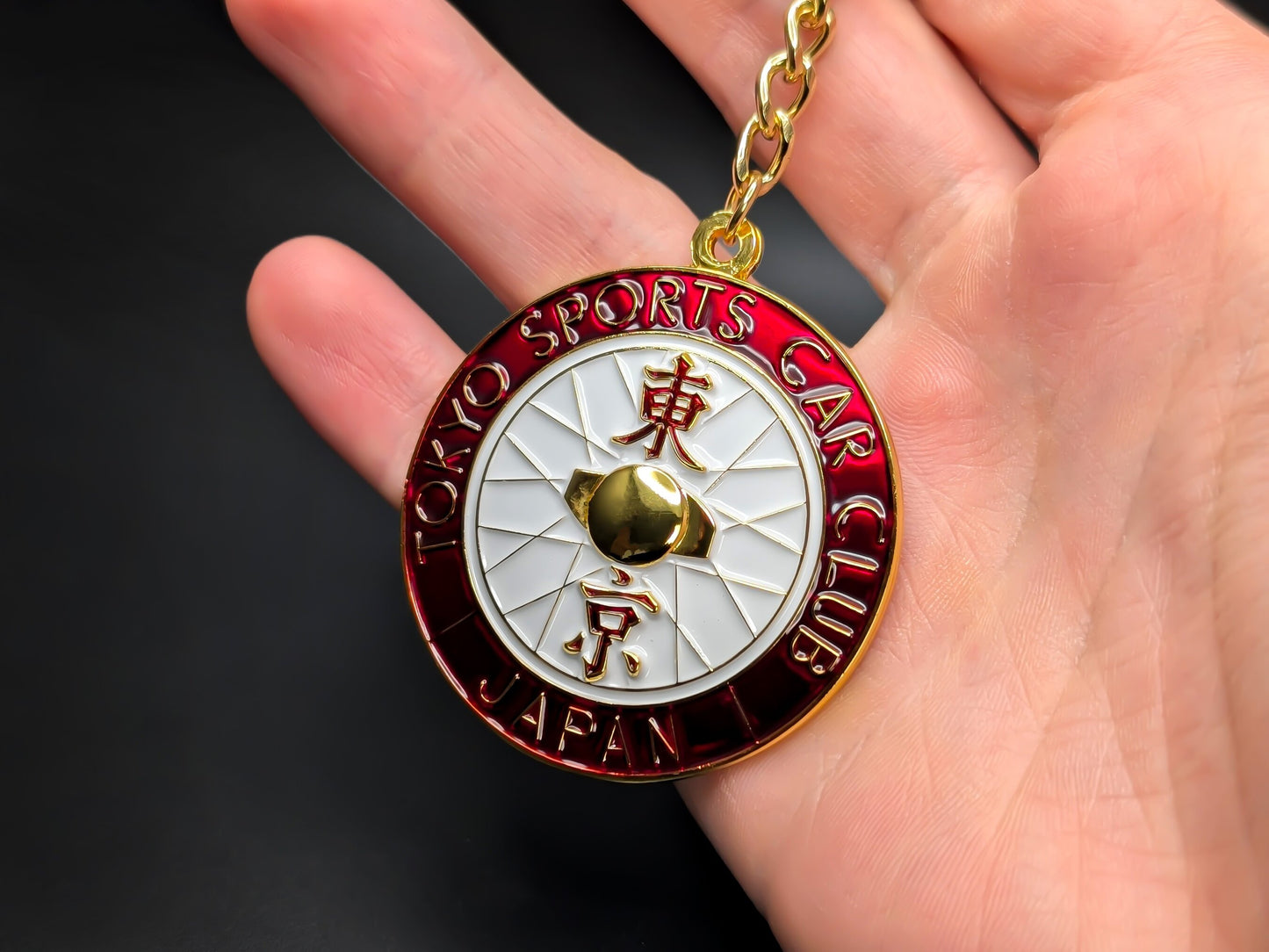
Most stories about the roots of Japanese tuning culture start in Shinjuku or out on the Wangan. This one starts behind a chain-link fence, on a strip of concrete built for cargo planes. The Tokyo Sports Car Club, the TSCC, grew out of American servicemen and the cars they shipped over, and the proof is stamped into a small enamel medallion: a Western wire wheel, with Japanese kanji laid right across the spokes.
A club built on a flightline
Postwar Tokyo was full of imported sports cars that had followed the occupation home. At Tachikawa, American mechanics, pilots, and officers used the base hobby shops to modify and restore Triumphs, MGs, and the V8 machinery they had brought from the States. By the middle of the decade that loose scene had organized into a club, and by around 1956 it had a fixed address: Hangar 5, on the Tachikawa flightline. A detailed history of the club describes weekend drives through the Kanto countryside that mixed enlisted men, officers, and a growing number of local Japanese drivers.
It helps to separate this club from the one it is constantly confused with. The Sports Car Club of Japan, the SCCJ, was founded in March 1951 and grew out of the British-rooted MG Car Club Japan Centre. It became a national administrative body, helped plan Fuji Speedway, and co-organized the first Japan Grand Prix in 1963, a path its own official history lays out. The TSCC was the opposite kind of outfit: grassroots, base-centric, and far more interested in what a car could do on a Saturday than in sanctioning a championship.
Gymkhana, red jackets, and the move to Yokota
The club left a discipline, not a trophy. The TSCC pioneered and popularized autocross in Japan, where it goes by gymkhana: a low-cost test of car control through cones, barrels, and tires, full of handbrake turns and left-foot braking. Tachikawa's disused taxiways were an ideal canvas, and by the late 1960s the meets were pulling in the surrounding Japanese community. Both clubs also raced at proper circuits, including Funabashi, the short-lived waterfront track between Tokyo and Chiba that opened in 1965 and was paved over within a few years; the LaLaPort shopping mall sits on the site today.
When Tachikawa Air Base closed, the club relocated to Yokota Air Base in 1977, and the cars changed with it. Classic American V8s, Mustangs and Camaros, now shared the lot with Datsun 240Zs and rotary Mazda RX-7s. At Yokota the club ran public exhibitions during the annual Friendship Festivals and held joint events with local Japanese clubs. This was its visible peak, and it had a uniform: bright red club jackets with a large TSCC patch embroidered across the back. Those jackets still surface at swap meets and surplus outlets, and a period example of the back patch has turned up in collector listings.
How a base badge became a badge of belonging
The badge reads like a small thesis about the whole club. It is a circular hard-enamel medallion on gold-plated metal: a thick outer ring in red and gold, a white spoked-wheel pattern at the center, and the kanji for Tokyo laid directly over the spokes. Vintage radiator-grille versions of this design still circulate among collectors. The wheel is Western engineering and mobility; the script is the country the club actually lived in. It was an American organization planted deep inside Japanese geography, and the emblem hid neither half.
Set it next to the older SCCJ grille badge, which placed a wire wheel in front of a red Shinto torii gate, the marker between the everyday and the sacred. That was a statement about reconciliation between nations. The TSCC badge is grittier and more literal, the work of airbase hot-rodders rather than diplomats.
The part enthusiasts care about came later. As the original meaning faded, the badge was adopted by Japan's underground street-racing (hashiriya) and classic-car (kyusha) subcultures. At late-night gatherings in the Daikoku and Tatsumi parking areas, among Hakosuka Skylines and S30 Fairlady Zs, these old cloisonne pins and keychains were prized and traded. The emblem became a badge of belonging: wearing one signaled a built-not-bought ethos and a working knowledge of where the scene came from, a straight line from a drift lot back to the runways at Tachikawa. That same exchange shaped men like Yutaka Katayama, a founder of the SCCJ later known as Mr. K, who would pry the Fairlady badges off United States-bound Zs and bolt on 240Z emblems in their place.
The cars at Tachikawa are long gone and the hangar doors are shut, but the little enamel wheel keeps turning up: in a swap-meet bin, on a jacket back, clipped to a set of keys at a midnight meet. It still says the same thing it always did.
In summary
Who founded the Tokyo Sports Car Club?
United States Air Force personnel founded it in the mid-1950s at Tachikawa Air Base, west of Tokyo. By around 1956 the club was headquartered in Hangar 5, a converted aircraft hangar on the flightline.
Is the Tokyo Sports Car Club the same as the Sports Car Club of Japan?
No. The Sports Car Club of Japan (SCCJ) is a separate, earlier national body founded in March 1951 out of the MG Car Club Japan Centre. The TSCC was a grassroots military and civilian club based on American air bases.
What does the Tokyo Sports Car Club badge mean?
It pairs a Western spoked wheel with Japanese kanji for Tokyo laid over the spokes, marking an American club based in Japan. In later decades it became a badge of belonging in classic-car and street-racing circles.
Where was the Tokyo Sports Car Club based?
It started at Tachikawa Air Base and moved to Yokota Air Base in 1977 after Tachikawa closed. Both bases sit in the western Tokyo area.
What is gymkhana, and what did the Tokyo Sports Car Club have to do with it?
Gymkhana is low-cost autocross run through cones, barrels, and tires, with the emphasis on car control. The TSCC pioneered and popularized it in Japan on disused airbase concrete.