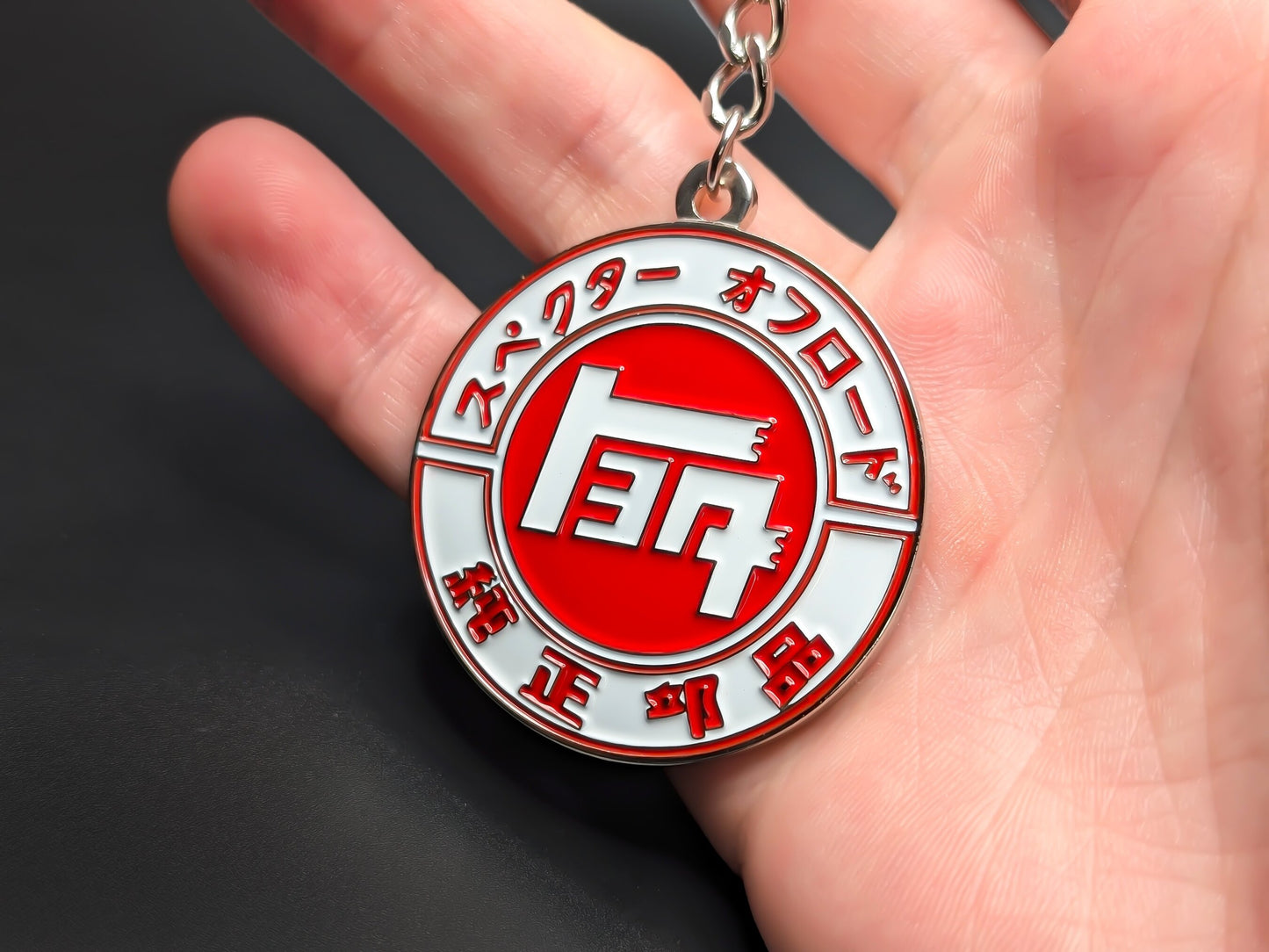
Toyota's katakana emblem: from 1936 trademark to JDM badge
A 1936 contest entry, eight brush strokes and a trick of the eye: how Toyota's katakana name came to read as TEQ.
Toyota's katakana emblem, the トヨタ mark that English speakers read as 'TEQ', dates to a 1936 design contest that drew more than 27,000 entries. Management changed the winning entry's final character from ダ to タ, cutting the name from ten brush strokes to eight. In Japan it read as plain Toyota, while abroad it looked like a code, and that gap helped turn a retired corporate mark into a JDM badge.
The mark was never meant to be a secret handshake. It was a trademark, and for a long time it was simply the company's name written in a circle. What turned it into something people hunt for and bolt to grilles is mostly what happened after Toyota stopped putting it front and center.
Eight strokes, one circle
In July 1936 the automotive department of Toyoda Automatic Loom Works ran a public contest for an emblem that could carry its advertising and stand apart from the family's textile business. More than 27,000 entries came in. At the September 25 selection meeting the winner was the company name in katakana, inside a circle.
Then the company changed it. The entry spelled Toyoda; management made it Toyota, and dropping the two dakuten marks took the name from ten brush strokes to eight. Eight was a lucky number in Japan: its kanji, 八, widens toward the base, a shape read as fortune spreading outward. The switch from Toyoda to Toyota has even drawn its own Language Log post.
Toyota's 75 Years archive gives the reasons in the company's own words: the characters were "visually simpler and less cluttered," the eight-stroke count was "associated with wealth and good fortune," and leaving the Toyoda name implied growth into "a broader-based social entity." The mark was registered as a trademark in April 1937, months before Toyota Motor Company was incorporated on August 28, 1937.

A 1936 Toyoda Model AA, built while the company still carried the Toyoda name.

The old TOYODA badge next to the katakana mark. The new emblem was registered as a trademark in April 1937.
Why English speakers read it as TEQ
Look at トヨタ with Latin eyes. ト has a vertical stem with a stroke running down to the right, close to a capital T. ヨ is three bars joined by a spine on the right, a reversed or blocky E. タ has a crossing top stroke and a curling tail that reads as a Q. The effect has a name, pareidolia: seeing letters where none were written.
Toyota's own histories of the emblem never call it TEQ, and nothing suggests it was ever an internal code or a sub-brand. It is collectors' shorthand. Stories grew around it anyway. Some owners will tell you it stands for Toyota Engineering and Quality, or Toyota Export Quality, or an early performance code that came before TRD. Nothing from Toyota backs any of them.
A mark nobody photographed for the brochure
The katakana mark was a working mark. It turns up on parts, castings, tool kits and Japan-market items, which is not the same as saying it sat on every Toyota's grille for fifty years. How widely it was used is harder to pin down than the legend suggests.
The clearest physical evidence is in the Land Cruiser tool kits. The FJ40 through FJ60 era trucks shipped with canvas tool rolls, and a detailed survey of those kits describes wrenches and pliers made under contract by Kyoto Tool Co. (KTC) and stamped with the katakana mark. Collectors call them TEQ tools, but the tools themselves carry the katakana. Owners also report the mark cast into engine parts on 22R-era Hilux, Celica and 4Runner powertrains, though that rests on enthusiast accounts rather than anything from Toyota.
The ovals, then the grey-market years
On October 2, 1989, for its 50th anniversary and the launch of Lexus, Toyota introduced the three-ovals emblem it still uses. Toyota's own account says the design took about five years. The two perpendicular inner ovals stand for the hearts of customer and company, and their overlap forms a T and a steering wheel. The outer oval stands for the world around Toyota. As the ovals took over, the katakana mark stepped back from mainstream branding.
In Japan, the old mark had simply been the company's name: ordinary, unremarkable, everywhere it happened to be. Outside Japan it had never read that way. To an English reader it was a puzzle with a plausible answer, and the people who knew what it really was had a small piece of insider knowledge.
That knowledge got its audience in the late 1990s and 2000s, when the JDM scene grew across North America, Europe and Australasia. Enthusiasts imported grey-market cars built for Japan: the AE86 Corolla Levin, the Land Cruiser 70, the Supra, the Chaser. According to owners' accounts, those cars arrived with the katakana mark on manuals, glass, engine tags and keys. Reading it as TEQ, and knowing it was really Toyota, became a quiet way of showing you knew the cars.
Stripes, grilles and a factory wink
By then Toyota's volume had made the oval look like the mark of mass-market cars. Truck and off-road builders began fitting old katakana badges to Tacoma, 4Runner, Tundra and FJ Cruiser grilles, often beside the yellow, orange and red stripes of Toyota's racing past. The pairing puts two eras of the company in one look.
Those badges come from aftermarket makers, not from Toyota. The factory's own nod has been the block TOYOTA lettering on some TRD Pro grilles: a hint in the same direction, not a revival of the 1936 mark.

A blacked-out katakana badge on a modern Toyota. These come from aftermarket makers, not from Toyota.
A circle with eight brush strokes in it began as a contest entry for a loom company's young car business. In Japan it read as a name and everywhere else as a riddle, and the riddle is why people keep wanting it.
In summary
What does the Toyota TEQ emblem actually say?
It spells Toyota in katakana (トヨタ). English speakers read the three characters as T, E and Q, which is where the nickname comes from.
Did Toyota ever use TEQ as an official name?
Toyota's own histories of the emblem never call it TEQ. The name is collectors' shorthand, and nothing from Toyota backs the stories that it means Toyota Engineering and Quality or Toyota Export Quality.
Why did Toyota change Toyoda to Toyota?
Dropping the dakuten marks cut the name from ten brush strokes to eight, a number linked with good fortune in Japan. Toyota's archive also cites a simpler look and a move from family business to broader enterprise.
When did the three-ovals emblem replace the katakana mark?
Toyota introduced the three-ovals emblem on October 2, 1989, for its 50th anniversary and the Lexus launch. The katakana mark stepped back from mainstream branding as the ovals took over.
Does Toyota sell an official katakana grille badge?
No official one is documented. Katakana grille badges come from aftermarket makers. Toyota's own retro touch has been the block TOYOTA lettering on some TRD Pro grilles.